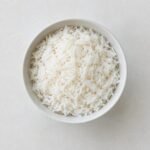
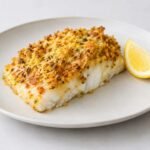
Salmon fillets roasted with a homemade teriyaki glaze of low-sodium soy, honey, ginger and garlic, portioned over short-grain rice, roasted broccoli and edamame. Bottled teriyaki is mostly sugar and salt; making it takes 3 minutes in a small saucepan and lets us control both. Edamame goes in for a second protein, since salmon is rich enough that more fish would push the bowl past where we wanted it: another ounce per bowl adds 60 kcal and 4 g fat.
One rimmed sheet pan and a small saucepan, 40 minutes. The broccoli goes in first and the salmon joins it for the last 10 to 12 minutes, so both finish together. Ask for skinless center-cut fillets of even thickness; tail pieces overcook before the thick ones are done. Frozen shelled edamame only needs thawing under warm water.
Why this one works
38 g protein per bowl: 26 g from a 4½-ounce salmon fillet and 6 g from the edamame, which adds its protein with under 3 g fat.
The glaze is low-sodium soy and one spoon of honey instead of bottled teriyaki: the honey adds 15 kcal per bowl, and the soy about 430 of the 540 mg sodium.
Half a cup of dry rice for four adds 85 kcal to each bowl, and a whole head of broccoli adds 2 g of the 6 g fiber.
Salmon reheats gently at half power and holds four days in the fridge; $3.70 a bowl, $2.53 of it the salmon.
Ingredient notes
Skinless salmon fillets (18 oz / 510 g). Four center-cut pieces of about 4½ ounces, roughly 1 inch thick. Farmed Atlantic is what most stores carry; wild salmon is leaner and cooks a minute or two faster. Low-sodium soy sauce (3 tbsp / 45 ml). The base of the glaze. Regular soy sauce adds 230 mg sodium per bowl; see the swaps table. Shelled edamame (1½ cups / 225 g). Sold frozen, already out of the pod. Thaw, pat dry, and they go straight into the bowl. Short-grain rice (½ cup / 95 g dry). Sold as sushi rice. It reheats soft, where long-grain rice turns firm in the fridge.
Scales every quantity and the servings count. The panel stays per serving.
½ cup(95 g) short-grain rice, such as sushi rice, rinsed
¾ cup(180 ml) water, for the rice
3 tbsp(45 ml) low-sodium soy sauce
1 tbsp(21 g) honey
1 tbsp(15 ml) rice vinegar
1 tsp(3 g) cornstarch
3 tbsp(45 ml) water, for the glaze
1 tbsp(6 g) finely grated fresh ginger
2garlic cloves (6 g), finely grated
1large head broccoli (350 g), cut into florets
2 tsp(9 g) canola oil
18 oz(510 g) skinless salmon fillets, in 4 pieces
1½ cups(225 g) frozen shelled edamame, thawed
2scallions (30 g), thinly sliced
2 tsp(6 g) toasted sesame seeds
Method
Heat the oven to 425 °F (220 °C) with a rack in the middle. Line a rimmed sheet pan with foil.
Combine the rice and ¾ cup water in a small saucepan. Bring to a boil, cover, reduce to low and cook 15 minutes. Rest off the heat, covered, 10 minutes.
Whisk the soy sauce, honey, vinegar, cornstarch, 3 tbsp water, ginger and garlic in a second small saucepan. Simmer over medium, stirring, 2 to 3 minutes, until thick enough to coat a spoon.
Toss the broccoli with the oil on the sheet pan and roast 10 minutes.
Push the broccoli to the edges. Set the salmon in the middle and brush the tops with half the glaze.
Roast 10 to 12 minutes, until the salmon flakes at the thickest point and reads 145 °F (63 °C), and the broccoli tips are charred.
Brush the salmon with the remaining glaze.
Divide the rice, salmon, broccoli and edamame among 4 containers. Scatter with scallions and sesame seeds.
Cook’s note
Thickening the glaze on the stove first is the technique: brushed on thin, it runs off and burns on the foil, where a reduced glaze stays on the fish and turns lacquered.
Storage
Refrigerate 4 days. Reheat at half power for 2 minutes with the lid loose, so the salmon warms through without drying out; it is also good cold. The salmon and rice freeze 2 months, though the broccoli softens on thawing.
Nutrition
Nutrition Facts
4 servings per recipeServing size 1 of 4 servings
Calories per serving500
% Daily Value*
Total Fat 23g
29%
Saturated Fat 4.5g
23%
Sodium 540mg
23%
Total Carbohydrate 36g
13%
Dietary Fiber 6g
21%
Total Sugars 8g
Protein 38g
76%
* The % Daily Value tells you how much a nutrient in a serving of food contributes to a daily diet. 2,000 calories a day is used for general nutrition advice.
How this panel was built
Every ingredient in this recipe is mapped to a USDA FoodData Central entry and the panel is computed from those entries for one serving as written. Optional ingredients and anything "to taste" are excluded. Values are rounded: protein to the gram, calories to the nearest 5 and sodium to the nearest 10 mg. The panel is calculated, not lab-tested; a different brand of stock or cheese will move sodium and fat. Cost per serving is an estimate at national-average store-brand prices; your store will differ.