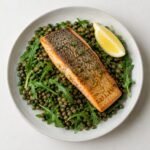
Salmon fillets under a glaze made with two mustards, smooth Dijon for heat and whole-grain for texture, sweetened with honey and baked hot and fast so the glaze sets before the fish dries. We hold back a third of the glaze and stir it into Greek yogurt with dill, which gives you a cold sauce at the table from the same bowl and no butter or mayonnaise.
Twenty-five minutes, one rimmed sheet pan and a sheet of parchment. Buy four skinless fillets of even thickness, about 1 inch, so they finish together; thin tail pieces overcook while thick center cuts catch up. We wrote this for Atlantic salmon because it is what most stores sell. Wild sockeye is thinner and needs 2 to 3 minutes less.
Why this one works
The glaze carries the flavor with half a tablespoon of honey per fillet, not a sticky sauce; the honey adds 30 kcal per serving.
The table sauce is leftover glaze stirred into Greek yogurt, with no butter or mayonnaise; the yogurt adds 10 kcal per serving.
The salmon is the whole protein of the plate at a 6 oz raw portion: 35 g of the 37 g protein per serving.
A hot oven and a short bake keep the fish moist without any added oil; 23 g of the 24 g fat per serving is the salmon's own.
Ingredient notes
Skinless Atlantic salmon fillets (1½ lb / 680 g). Four 6 oz pieces cut from the center of the side. Skin-on works; peel it off after baking or eat it. Dijon and whole-grain mustard (3 tbsp total / 45 g). Dijon brings the heat and holds the glaze together; the whole seeds give it texture. All Dijon works. Honey (2 tbsp / 42 g). Enough to brown on top and round off the mustard. Maple syrup is a straight swap. 2 percent Greek yogurt (¼ cup / 60 g). For the table sauce. Nonfat works and is a little sharper.
Scales every quantity and the servings count. The panel stays per serving.
1½ lb(680 g) skinless Atlantic salmon fillets (4 pieces, about 1 inch thick)
¼ tsp(1.5 g) fine salt
¼ tsp(0.5 g) black pepper
2 tbsp(30 g) Dijon mustard
1 tbsp(15 g) whole-grain mustard
2 tbsp(42 g) honey
1garlic clove (3 g), grated
1 tbsp(15 ml) lemon juice
¼ cup(60 g) 2% Greek yogurt
1 tbsp(4 g) fresh dill, chopped
Lemon wedges, optional
Method
Heat the oven to 425 °F (220 °C) with a rack in the upper-middle position. Line a rimmed half-sheet pan with parchment.
Pat the salmon dry and lay it on the pan, 2 inches apart. Season with the salt and pepper.
Whisk the Dijon, whole-grain mustard, honey, garlic and lemon juice in a small bowl.
Spoon about two-thirds of the glaze over the fillets and spread it over the tops and sides.
Bake 10 to 13 minutes, until the thickest part flakes and reads 145 °F (63 °C).
While it bakes, stir the remaining glaze into the yogurt with the dill.
Rest the salmon 3 minutes on the pan. Serve with the yogurt sauce and lemon wedges.
Cook’s note
The upper rack and a 425 °F oven set the glaze on top in the time the center takes to cook, so it browns without a broiler and without sliding off onto the parchment.
Storage
Refrigerate up to 2 days; eat it cold, flaked over a salad, or warm it gently at 275 °F for 10 minutes. The yogurt sauce keeps 4 days. Cooked salmon does not freeze well.
Nutrition
Nutrition Facts
4 servings per recipeServing size 1 of 4 servings
Calories per serving410
% Daily Value*
Total Fat 24g
31%
Saturated Fat 5g
25%
Sodium 350mg
15%
Total Carbohydrate 11g
4%
Dietary Fiber 0.5g
2%
Total Sugars 9g
Protein 37g
74%
* The % Daily Value tells you how much a nutrient in a serving of food contributes to a daily diet. 2,000 calories a day is used for general nutrition advice.
How this panel was built
Every ingredient in this recipe is mapped to a USDA FoodData Central entry and the panel is computed from those entries for one serving as written. Optional ingredients and anything "to taste" are excluded. Values are rounded: protein to the gram, calories to the nearest 5 and sodium to the nearest 10 mg. The panel is calculated, not lab-tested; a different brand of stock or cheese will move sodium and fat. Cost per serving is an estimate at national-average store-brand prices; your store will differ.