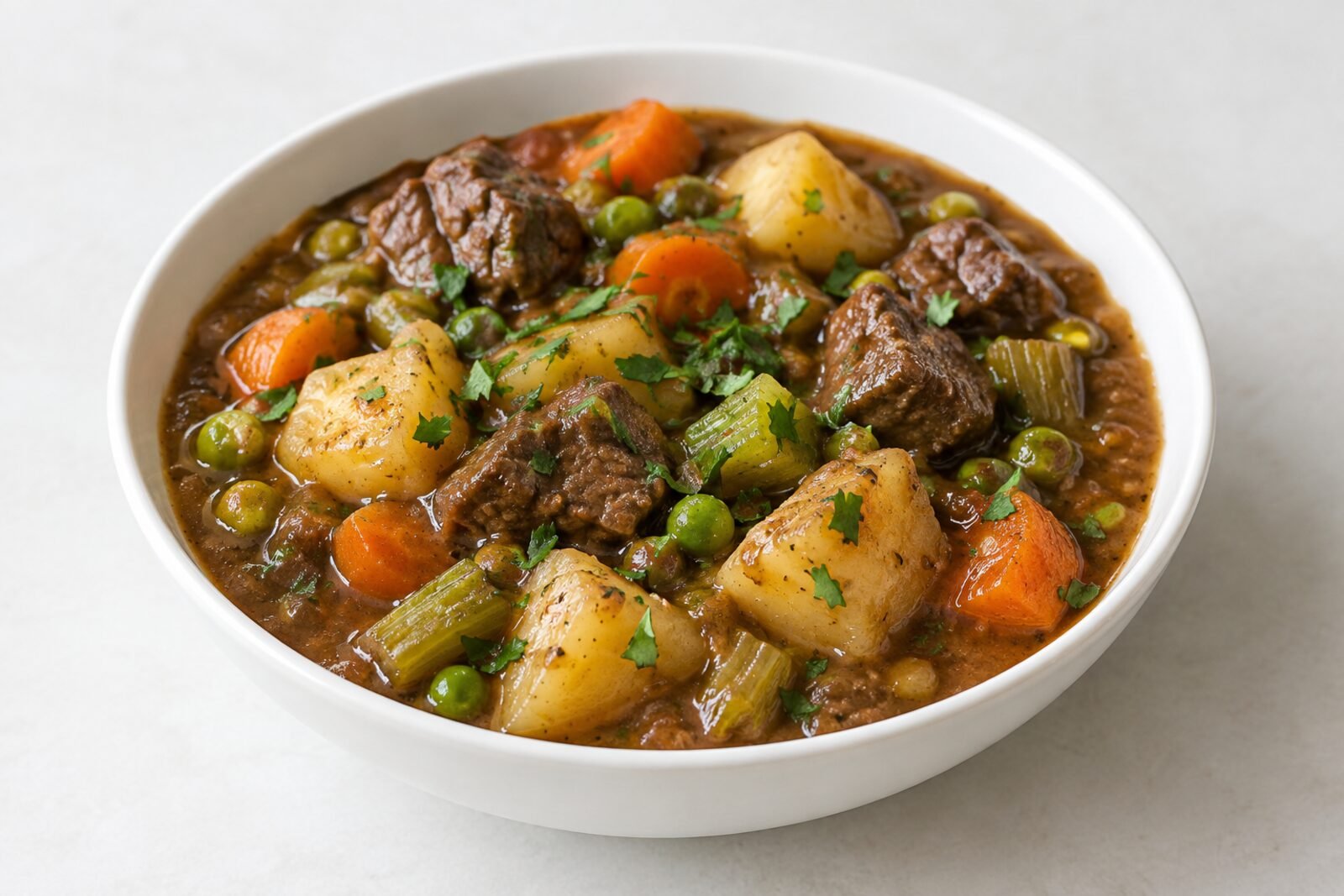
Classic beef stew dredges the meat in flour and thickens the gravy with it. We skip the flour: the chuck browns better without a coat, and at the end a few chunks of potato get mashed back into the pot, which turns the broth to gravy in about a minute. Tomato paste cooked in the browning fat supplies the toasted depth the flour used to.
About 35 minutes of trimming and browning, then 8 hours on low or 5 on high in a 6-quart cooker. Buy a whole chuck roast, about 2¾ lb, and trim and cube it yourself; packaged stew meat mixes cuts that cook unevenly. Choose Yukon Golds over russets so the chunks hold together.
Why this one works
43 g protein per serving, 37 g of it from the 2¼ lb of chuck, with the outside fat cut away before cooking.
Mashed potato thickens the gravy, so there is no flour or butter roux, and the fat stays at 11 g per serving.
Carrots, potatoes and peas make it a full plate from the one cooker: 6 g fiber per serving.
Low-sodium stock and a measured teaspoon of salt keep the seasoning in your hands; the salt is about 390 mg of the 780 mg sodium per serving.
Ingredient notes
Beef chuck roast (2¼ lb / 1020 g after trimming). Buy about 2¾ lb and cut away the outside fat and thick seams. Chuck has the connective tissue that turns tender over 8 hours; leaner round goes dry and stringy. Yukon Gold potatoes (1½ lb / 680 g). They hold their shape through the long cook and mash smooth at the end. Russets fall apart and cloud the gravy. Tomato paste (2 tbsp / 32 g). Cooked in the browning fat for a minute until it darkens. This is where the depth comes from without a flour-browned base. Low-sodium beef stock (2 cups / 480 ml). Half of it lifts the browned bits off the skillet, so nothing is left behind in the pan. Regular stock puts 150 mg more sodium in each serving.
Scales every quantity and the servings count. The panel stays per serving.
2¼ lb(1,020 g) beef chuck roast, trimmed of visible fat (trimmed weight), cut into 1½-inch cubes
1 tsp(6 g) fine salt
½ tsp(1 g) ground black pepper
1 tbsp(14 g) olive oil
2 tbsp(32 g) tomato paste
2 cups(480 ml) low-sodium beef stock, divided
1 tbsp(15 ml) Worcestershire sauce
1medium yellow onion (150 g), cut into 8 wedges
3garlic cloves (9 g), smashed
4medium carrots (240 g), cut into 1-inch pieces
2celery ribs (80 g), cut into 1-inch pieces
1½ lb(680 g) Yukon Gold potatoes, cut into 1½-inch chunks
1 tsp(1 g) dried thyme
2bay leaves (0.5 g)
1 cup(140 g) frozen peas
2 tbsp(8 g) parsley, chopped
Method
Pat the beef dry with paper towels and season with the salt and pepper.
Heat the oil in a 12-inch skillet over medium-high. Brown half the beef 6 minutes, turning once, until dark on two sides. Move it to a 6-quart slow cooker and brown the rest.
Lower the heat to medium. Stir the tomato paste into the fat for 1 minute, until it darkens.
Add 1 cup of the stock and the Worcestershire and scrape up every browned bit. Pour it over the beef.
Add the onion, garlic, carrots, celery, thyme and bay leaves, then the potatoes on top. Pour in the remaining stock.
Cover and cook on LOW for 8 hours or HIGH for 5 hours, until the beef is fork-tender. It is safe at 145 °F (63 °C) but tender only near 200 °F (93 °C).
Remove the bay leaves. Lift out 4 potato chunks, mash them in a bowl with a ladle of broth, and stir the mash back in.
Stir in the peas, cover and cook 15 minutes. Top with the parsley.
Cook’s note
Browning the beef in two batches, so the cubes never touch, is the difference between a dark crust and grey steamed meat; without flour, that crust is the only browning the stew gets.
Storage
Refrigerate 4 days. Freeze 3 months, though the potatoes soften a little after thawing. Reheat covered on the stove with a splash of stock.
Nutrition
Nutrition Facts
6 servings per recipeServing size 1 of 6 servings
Calories per serving395
% Daily Value*
Total Fat 11g
14%
Saturated Fat 3.5g
18%
Sodium 780mg
34%
Total Carbohydrate 30g
11%
Dietary Fiber 6g
21%
Total Sugars 7g
Protein 43g
86%
* The % Daily Value tells you how much a nutrient in a serving of food contributes to a daily diet. 2,000 calories a day is used for general nutrition advice.
How this panel was built
Every ingredient in this recipe is mapped to a USDA FoodData Central entry and the panel is computed from those entries for one serving as written. Optional ingredients and anything "to taste" are excluded. Values are rounded: protein to the gram, calories to the nearest 5 and sodium to the nearest 10 mg. The panel is calculated, not lab-tested; a different brand of stock or cheese will move sodium and fat. Cost per serving is an estimate at national-average store-brand prices; your store will differ.