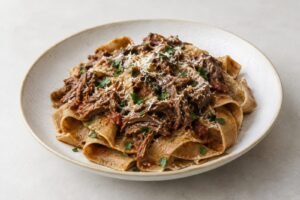
A ragu that starts from a whole chuck roast instead of ground beef, browned in four big pieces and braised in crushed tomatoes until it falls into long shreds. The onion, carrot and celery cook in the beef’s browning fat first, which is most of the flavor, so the whole pot needs only 2 tsp of oil. It goes over whole-wheat pasta at a stated portion, 1½ oz dry per bowl, with the ragu as the bulk of the plate.
Twenty minutes of chopping and 15 of browning, then 8 hours on low or 5 on high in a 6-quart cooker, and 12 minutes for the pasta at the end. Trim the outside fat from the roast before browning; skim whatever renders off the top after shredding. The ragu freezes; the pasta is cooked fresh.
Why this one works
43 g protein per serving: 33 g from the chuck and 6 g from the stated pasta portion, 1½ oz (43 g) dry per bowl.
Cooking the soffritto in the beef's fat means 2 tsp of oil is enough for the pot; the oil adds 15 kcal a serving.
Whole-wheat pasta brings 4 g of the 8 g fiber per serving; regular semolina pasta drops 2.5 g.
The ragu freezes in portions for 3 months and only the pasta is cooked on the night, at $3.17 a serving all in.
Ingredient notes
Beef chuck roast (2 lb / 910 g after trimming). Browned in four large pieces, not cubes, so it shreds into long strands that cling to pasta. Buy about 2½ lb and trim the outside fat. Whole-wheat pappardelle or rigatoni (9 oz / 255 g dry). That is 1½ oz (43 g) dry per bowl, smaller than a restaurant plate on purpose. Wide or tube shapes catch the shreds. Onion, carrot and celery (350 g together). Finely diced and cooked 5 minutes in the skillet. This is the soffritto, and it is why the ragu tastes long-cooked rather than boiled. Crushed tomatoes (one 28 oz can / 794 g). Crushed, not purée, for some texture. The no-salt-added can is in the swaps table: −230 mg sodium per serving.
Scales every quantity and the servings count. The panel stays per serving.
2 lb(910 g) beef chuck roast, trimmed of visible fat (trimmed weight), cut into 4 pieces
1 tsp(6 g) fine salt
½ tsp(1 g) ground black pepper
2 tsp(9 g) olive oil
1medium yellow onion (150 g), finely diced
2medium carrots (120 g), finely diced
2celery ribs (80 g), finely diced
4garlic cloves (12 g), minced
2 tbsp(32 g) tomato paste
½ cup(120 ml) low-sodium beef stock
128 oz can (794 g) crushed tomatoes
1rosemary sprig (2 g)
2bay leaves (0.5 g)
9 oz(255 g) whole-wheat pappardelle or rigatoni
2 tbsp(8 g) parsley, chopped
Grated parmesan, optional, for serving (skip for dairy-free)
Method
Season the beef on all sides with the salt and pepper.
Heat the oil in a 12-inch skillet over medium-high. Brown the beef 3 minutes per side, about 10 minutes in all, until dark. Move it to a 6-quart slow cooker.
Lower the heat to medium. Add the onion, carrots and celery to the skillet and cook 5 minutes, scraping the pan, until soft.
Stir in the garlic and tomato paste for 1 minute, then pour in the stock and scrape the pan clean. Pour it over the beef.
Add the tomatoes, rosemary and bay leaves. Cover and cook on LOW for 8 hours or HIGH for 5 hours.
The beef is done when it falls apart at a fork's touch; it is safe at 145 °F (63 °C) but shreds only near 200 °F (93 °C).
Remove the rosemary stem and bay leaves. Shred the beef in the pot with two forks and skim any fat from the surface. Leave uncovered on WARM for 10 minutes.
Meanwhile cook the pasta in a large pot of boiling water 1 minute short of the package time. Reserve ½ cup (120 ml) of the water and drain.
Toss the pasta with a third of the ragu and a splash of pasta water. Divide among 6 bowls, spoon the rest of the ragu over and top with parsley.
Cook’s note
Leaving the shredded beef uncovered in the sauce for 10 minutes lets the strands take up the tomato instead of staying as dry threads on top.
Storage
Refrigerate the ragu 4 days or freeze 3 months, without the pasta. Cook the pasta fresh for each meal and reheat the ragu covered on the stove.
Nutrition
Nutrition Facts
6 servings per recipeServing size 1 of 6 servings
Calories per serving445
% Daily Value*
Total Fat 11g
14%
Saturated Fat 3.5g
18%
Sodium 810mg
35%
Total Carbohydrate 48g
17%
Dietary Fiber 8g
29%
Total Sugars 10g
Protein 43g
86%
* The % Daily Value tells you how much a nutrient in a serving of food contributes to a daily diet. 2,000 calories a day is used for general nutrition advice.
How this panel was built
Every ingredient in this recipe is mapped to a USDA FoodData Central entry and the panel is computed from those entries for one serving as written. Optional ingredients and anything "to taste" are excluded. Values are rounded: protein to the gram, calories to the nearest 5 and sodium to the nearest 10 mg. The panel is calculated, not lab-tested; a different brand of stock or cheese will move sodium and fat. Cost per serving is an estimate at national-average store-brand prices; your store will differ.