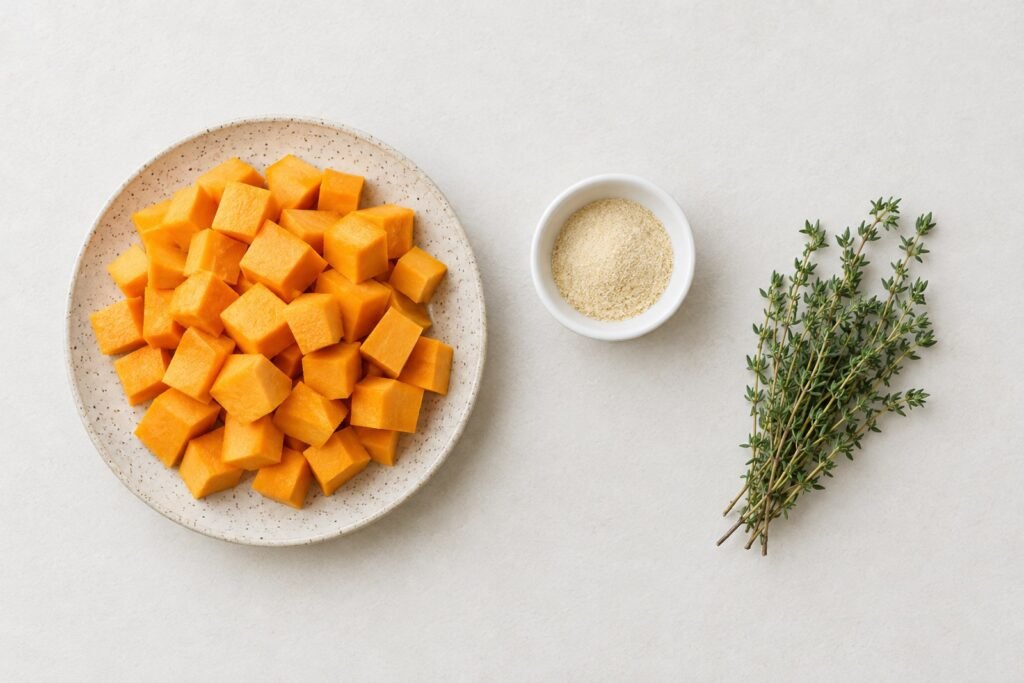
Roasted butternut squash is the easiest fall side there is: cubes of squash tossed with olive oil, salt, pepper and a little garlic, roasted in a hot oven until they are tender inside and caramelized at the edges, then finished with fresh thyme. Roasting brings out the squash’s natural sweetness, so it needs no sugar.
About 55 minutes, 20 of them peeling and cutting, with one sheet pan. A bag of precut squash skips that step. It roasts at the same temperature as the Brussels sprouts and reheats well, so it can be made earlier in the day and warmed while the roast turkey breast rests.
Why this one works
No sugar or syrup; the squash sweetens as it roasts: 3.5 g sugars per serving, all from the squash.
Two tablespoons of olive oil for six servings: 4.5 g fat per serving, almost all of it from the oil.
A kilo of squash for six: 3.5 g fiber and 75 of the 115 calories per serving.
Half a teaspoon of salt for the whole pan: 195 of the 200 mg sodium per serving; $0.80 a serving.
Ingredient notes
Butternut squash (2¼ lb / 1 kg peeled and seeded). One squash of about 3 lb gives this much. Look for a heavy one with matte, unblemished skin. Precut cubes from the produce section work too; cut any big ones down to 1 inch. Olive oil (2 tbsp / 27 g). Coats the cubes so they brown rather than steam. Garlic powder (½ tsp). Fresh garlic burns in the oven's heat; the powder gives the same savory note without scorching. Fresh thyme (2 tsp leaves). Added at the end so it stays green; ½ tsp dried thyme, tossed in with the oil, works too.
Scales every quantity and the servings count. The panel stays per serving.
2¼ lb(1 kg) peeled and seeded butternut squash, cut into 1-inch cubes (from one 3 lb squash)
2 tbsp(27 g) olive oil
½ tsp(3 g) fine salt
¼ tsp(0.6 g) black pepper
½ tsp(1.5 g) garlic powder
2 tsp(1.5 g) fresh thyme leaves
Method
Heat the oven to 425 °F (220 °C) with a rack in the middle. If you're starting with a whole squash, cut off both ends, peel it with a sharp vegetable peeler, halve it lengthwise, scoop out the seeds and cut it into 1-inch cubes.
On a large rimmed baking sheet, toss the squash with the oil, salt, pepper and garlic powder. Spread it out in a single layer with a little space between the cubes.
Roast 30 to 35 minutes, turning the cubes once halfway, until a knife slides through easily and the edges are browned.
Scatter the thyme over the squash, toss and serve hot.
Cook’s note
Cut the cubes the same size, about 1 inch, so they're all done at once. To cut a whole squash safely, slice off a thin strip along one side first so it sits flat on the board and doesn't roll.
Storage
Refrigerate within 2 hours, up to 4 days. Reheat on a sheet pan at 400 °F (200 °C) for about 10 minutes, or in the microwave. It freezes up to 3 months, though it's softer after thawing; it's best then for soup or mash.
Nutrition
Nutrition Facts
6 servings per recipeServing size 1 of 6 servings
Calories per serving115
% Daily Value*
Total Fat 4.5g
6%
Saturated Fat 0.5g
3%
Sodium 200mg
9%
Total Carbohydrate 20g
7%
Dietary Fiber 3.5g
13%
Total Sugars 3.5g
Protein 2g
4%
* The % Daily Value tells you how much a nutrient in a serving of food contributes to a daily diet. 2,000 calories a day is used for general nutrition advice.
How this panel was built
Every ingredient in this recipe is mapped to a USDA FoodData Central entry and the panel is computed from those entries for one serving as written. Optional ingredients and anything "to taste" are excluded. Values are rounded: protein to the gram, calories to the nearest 5 and sodium to the nearest 10 mg. The panel is calculated, not lab-tested; a different brand of stock or cheese will move sodium and fat. Cost per serving is an estimate at national-average store-brand prices; your store will differ.