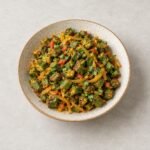
Hobak bokkeum is a quick Korean side dish of zucchini stir-fried with garlic and seasoned with salted shrimp, the tiny fermented shrimp sold in jars at Korean markets. The shrimp do the job soy sauce does elsewhere, adding salt and a savory depth without darkening the zucchini, which stays pale green and just tender. A teaspoon of toasted sesame oil and a few sesame seeds go in at the end.
A 12-inch skillet and under 20 minutes. Look for salted shrimp (saeujeot) in the refrigerated section of a Korean market; a small jar keeps for months in the fridge and also seasons soups and steamed eggs. Korean zucchini (aehobak), paler and sweeter, is the traditional choice, but regular zucchini works. Take the pan off the heat while the zucchini still has some bite, because it keeps softening as it sits.
Why this one works
Two teaspoons of salted shrimp season a pound and a half of zucchini with no soy sauce to darken it: about 220 mg of the 230 mg sodium per serving.
The zucchini is the dish: 1½ lb for four, at 70 calories and 2 g fiber per serving.
Two teaspoons of canola oil cook it and one of toasted sesame oil finishes it: 3.5 g of the 4.5 g fat per serving.
18 minutes and $0.79 a serving, $0.60 of it the zucchini.
Ingredient notes
Salted shrimp (saeujeot, 2 tsp / 10 g). Tiny shrimp fermented in salt, sold in jars in the refrigerated aisle of Korean markets. Chop them finely so the salt spreads evenly. Without them, use ½ tsp fine salt; the swaps table shows the change. Zucchini (1½ lb / 680 g). About three medium. Korean zucchini (aehobak) is paler, sweeter and softer; either works with the same timing. Cut the half-moons evenly, ¼ inch thick, so they cook at the same rate. Toasted sesame oil (1 tsp / 4.5 g). Stirred in off the heat for flavor; the canola oil does the cooking.
Heat the canola oil in a 12-inch skillet over medium-high until it shimmers. Add the onion and cook 1 minute, stirring, until it starts to soften.
Add the zucchini and spread it out. Cook 3 minutes, stirring once or twice, until the edges turn translucent and a few pieces start to color.
Add the garlic and salted shrimp and stir-fry 2 minutes, until the zucchini is just tender but still bright and holding its shape.
Off the heat, stir in the sesame oil, scallion, sesame seeds and gochugaru, if using. Serve warm or at room temperature.
Cook’s note
Add the salted shrimp only after the zucchini has started to color: salt added at the start draws water out of the zucchini, and it stews instead of searing.
Storage
Keeps 3 days in the fridge, covered. Serve it cold or at room temperature, as most Korean side dishes are, or warm it briefly in a skillet. Does not freeze; the zucchini turns watery.
Nutrition
Nutrition Facts
4 servings per recipeServing size 1 of 4 servings
Calories per serving70
% Daily Value*
Total Fat 4.5g
6%
Saturated Fat 0.5g
3%
Sodium 230mg
10%
Total Carbohydrate 7g
3%
Dietary Fiber 2g
7%
Total Sugars 5g
Protein 3g
6%
* The % Daily Value tells you how much a nutrient in a serving of food contributes to a daily diet. 2,000 calories a day is used for general nutrition advice.
How this panel was built
Every ingredient in this recipe is mapped to a USDA FoodData Central entry and the panel is computed from those entries for one serving as written. Optional ingredients and anything "to taste" are excluded. Values are rounded: protein to the gram, calories to the nearest 5 and sodium to the nearest 10 mg. The panel is calculated, not lab-tested; a different brand of stock or cheese will move sodium and fat. Cost per serving is an estimate at national-average store-brand prices; your store will differ.