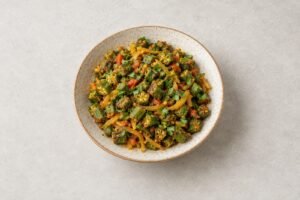
Bhindi masala is the dry okra dish served across North India as a side to dal and roti: okra rounds fried in an open pan until they brown and lose their slipperiness, then tossed with onion, tomato and a short list of ground spices. It is a dry dish, not a curry; the spices cling to the okra rather than sit in a sauce. Lemon juice and cilantro go in at the end to sharpen it.
A 12-inch skillet and about 35 minutes. Buy small, firm okra pods that snap rather than bend, and dry them completely after washing; water on the okra is what makes it slimy. Cook it uncovered and leave the salt until the end, since a lid or early salt both draw out moisture and stew the okra. Most Indian kitchens add a pinch of hing (asafoetida); it is usually cut with wheat flour, so we leave it out to keep the dish gluten-free.
Why this one works
A full pound of okra for four servings is the dish: most of the 5 g fiber per serving.
One tablespoon of oil in an open pan browns the okra instead of frying it in a pool of fat: 3.5 g of the 4 g fat per serving.
Half a teaspoon of salt goes in at the end, where it seasons without drawing water out of the okra: 290 mg of the 300 mg sodium per serving.
Vegan and gluten-free as written, at $1.46 a serving.
Ingredient notes
Fresh okra (1 lb / 450 g). Choose pods no longer than your finger; large pods are woody. Wash them, then dry each one with a towel and let them air-dry for 10 minutes before cutting. Frozen cut okra works if cooked from frozen in a hot pan, but it browns less. Cumin seeds (1 tsp / 2 g). Toasted whole in the oil first, they flavor the oil the okra cooks in. Ground cumin does not do the same job. Lemon juice (1 tbsp / 15 ml). Many cooks use amchur (dried green mango powder) for the sour note; ½ tsp amchur in place of the lemon juice is the traditional choice if you have it.
Scales every quantity and the servings count. The panel stays per serving.
1 lb(450 g) fresh okra, washed, dried, trimmed and cut into ½-inch rounds
1 tbsp(14 g) canola oil
1 tsp(2 g) cumin seeds
1medium yellow onion (150 g), thinly sliced
3garlic cloves (9 g), minced
2 tsp(4 g) grated fresh ginger
1green Thai chile (2 g), slit lengthwise
1medium tomato (123 g), chopped
½ tsp(1.5 g) ground turmeric
1 tsp(2 g) ground coriander
½ tsp(1.2 g) sweet paprika
½ tsp(1 g) garam masala
1 tbsp(15 ml) lemon juice
½ tsp(3 g) fine salt
2 tbsp(6 g) chopped cilantro
Method
Heat the oil in a 12-inch skillet over medium-high until it shimmers. Add the cumin seeds and let them sizzle for 20 seconds, until fragrant.
Add the okra and spread it into one layer. Cook uncovered 8 to 10 minutes, stirring every 2 minutes, until the okra is browned in spots and no longer sticky when you stir it.
Push the okra to the sides, add the onion to the center and cook 4 minutes, stirring, until soft and golden at the edges.
Add the garlic, ginger and chile and stir 1 minute. Add the tomato, turmeric, coriander and paprika and cook 3 minutes, stirring gently, until the tomato breaks down and coats the okra.
Lower the heat to medium. Sprinkle over the garam masala, lemon juice and salt and toss for 1 minute.
Off the heat, scatter over the cilantro. Serve hot.
Cook’s note
The okra goes in before the onion and tomato for a reason: it needs the pan's full heat, uncrowded, to brown and set its surface. Once that happens it stops releasing the sticky juice, and the wetter ingredients can go in without turning it slimy.
Storage
Keeps 3 days in the fridge, covered. Reheat in a dry skillet over medium heat for 3 to 4 minutes; the microwave softens it. Does not freeze well; the okra turns soft and slippery.
Nutrition
Nutrition Facts
4 servings per recipeServing size 1 of 4 servings
Calories per serving100
% Daily Value*
Total Fat 4g
5%
Saturated Fat 0.5g
3%
Sodium 300mg
13%
Total Carbohydrate 15g
5%
Dietary Fiber 5g
18%
Total Sugars 4.5g
Protein 3g
6%
* The % Daily Value tells you how much a nutrient in a serving of food contributes to a daily diet. 2,000 calories a day is used for general nutrition advice.
How this panel was built
Every ingredient in this recipe is mapped to a USDA FoodData Central entry and the panel is computed from those entries for one serving as written. Optional ingredients and anything "to taste" are excluded. Values are rounded: protein to the gram, calories to the nearest 5 and sodium to the nearest 10 mg. The panel is calculated, not lab-tested; a different brand of stock or cheese will move sodium and fat. Cost per serving is an estimate at national-average store-brand prices; your store will differ.