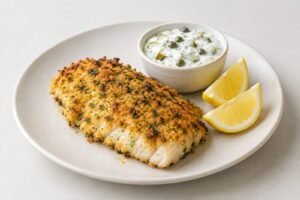
Thick cod fillets brushed with Dijon and egg white, pressed into a panko and parsley crust on top only, and cooked without turning so the crust stays where you put it. The tartar sauce is Greek yogurt with chopped dill pickle, capers, lemon and dill, as sharp as the mayonnaise kind. Crusting only the top is the air-fryer adjustment: a fully coated fillet sticks underneath and tears when you flip it.
Thirty minutes, and the sauce gets stirred together while the fish cooks. Four fillets fit in one layer in a 6-quart basket; a smaller basket needs two batches. Buy center-cut cod about 1 inch thick, since thin tail pieces cook through before the crust browns. Frozen cod loins are a good buy: thaw overnight in the fridge and pat them very dry.
Why this one works
Cod is lean: it brings 30 g of the 36 g protein per serving but only about 1 g of the 4.5 g fat, so the measured crust and sauce supply the rest.
Crusting the top only takes ½ cup of panko and 2 tsp of oil for four fillets, which adds about 50 kcal per serving, and needs no flip.
The tartar sauce is Greek yogurt, not mayonnaise, and gives 4 g protein per serving from ⅔ cup of 2% yogurt.
Capers and pickle season the sauce, so the fish gets only ¼ tsp salt: 420 mg sodium per serving, 200 mg less without the capers and salt.
Ingredient notes
Center-cut cod fillets (1½ lb / 680 g). Four pieces about 1 inch thick, Pacific or Atlantic. Haddock and pollock cook the same way. Panko (½ cup / 30 g). Japanese-style breadcrumbs. The flakes are larger than regular crumbs, so they crisp instead of packing down. Whole-wheat panko works. Egg white (1 large / 33 g). Whisked with the Dijon, it is the glue that holds the crust on without a flour step. Plain Greek yogurt (2%, ⅔ cup / 150 g). The tartar base. Stir in the pickle and capers shortly before serving so the sauce does not turn watery.
Scales every quantity and the servings count. The panel stays per serving.
1½ lb(680 g) center-cut cod fillets, four about 1 inch thick
¼ tsp(1.5 g) fine salt
¼ tsp(0.5 g) black pepper
1large egg white (33 g)
1 tbsp(15 g) Dijon mustard
½ cup(30 g) panko
2 tbsp(8 g) parsley, finely chopped
½ tsp(1.5 g) garlic powder
2 tsp(9 g) olive oil
⅔ cup(150 g) 2% plain Greek yogurt
2 tbsp(30 g) dill pickle, finely chopped
1 tbsp(9 g) capers, drained and chopped
1 tbsp(15 ml) lemon juice
1 tbsp(1 g) fresh dill, chopped
Lemon wedges, optional
Method
Preheat the air fryer to 400 °F (200 °C) for 3 minutes. Line the basket with perforated parchment.
Pat the cod very dry and season both sides with the salt and pepper.
Whisk the egg white and Dijon in a small bowl. In another bowl, rub the panko, parsley and garlic powder with the oil until evenly damp.
Brush the tops and sides of the fillets with the egg-white mixture. Press the panko onto the tops in a thick layer.
Set the fillets crust side up in a single layer. In a basket under 6 quarts, cook two at a time.
Cook 9 to 11 minutes without turning, until the crust is deep golden and the thickest part flakes and reads 145 °F (63 °C).
While the fish cooks, stir the yogurt, pickle, capers, lemon juice and dill together. Serve with the cod and lemon wedges.
Cook’s note
Rubbing the oil into the panko before it goes on, rather than spraying afterwards, is what browns the crust evenly instead of in pale and dark patches.
Storage
Best eaten right away, because the crust softens in the fridge. Refrigerate 2 days with the sauce kept separately, and re-crisp 4 minutes at 350 °F (175 °C). Does not freeze once cooked.
Nutrition
Nutrition Facts
4 servings per recipeServing size 1 of 4 servings
Calories per serving225
% Daily Value*
Total Fat 4.5g
6%
Saturated Fat 1g
5%
Sodium 420mg
18%
Total Carbohydrate 8g
3%
Dietary Fiber 0.5g
2%
Total Sugars 2g
Protein 36g
72%
* The % Daily Value tells you how much a nutrient in a serving of food contributes to a daily diet. 2,000 calories a day is used for general nutrition advice.
How this panel was built
Every ingredient in this recipe is mapped to a USDA FoodData Central entry and the panel is computed from those entries for one serving as written. Optional ingredients and anything "to taste" are excluded. Values are rounded: protein to the gram, calories to the nearest 5 and sodium to the nearest 10 mg. The panel is calculated, not lab-tested; a different brand of stock or cheese will move sodium and fat. Cost per serving is an estimate at national-average store-brand prices; your store will differ.