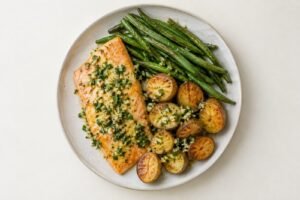
One pan, three things that cook at different speeds. Halved baby potatoes go in alone for 20 minutes, cut side down so they brown against the metal; then green beans and salmon fillets brushed with Dijon and lemon zest join them for the last 12 or so. A parsley and lemon gremolata with no oil goes over at the end, so the only added fat in the pan is two teaspoons of olive oil.
Fifty minutes, mostly in the oven, and one 18 × 13-inch rimmed sheet pan. Buy skinless fillets about 1 inch thick so they finish with the beans; thin tail pieces overcook. Thin French green beans cook in the same time as the fish. Thick supermarket beans want a 4-minute head start before the salmon goes in.
Why this one works
The salmon is set by weight, 5½ oz raw per plate, for 32 g of the 36 g protein; the pound of potatoes adds 80 kcal per serving.
Two teaspoons of oil for the whole pan adds 20 kcal per serving; the salmon brings 21 g of the 24 g fat.
Dijon and a no-oil gremolata carry the flavor for under 10 kcal per serving, with no butter or cream sauce.
A full pound of green beans makes vegetables half the pan, not a garnish, and supplies 3 g of the 6 g fiber per serving.
Ingredient notes
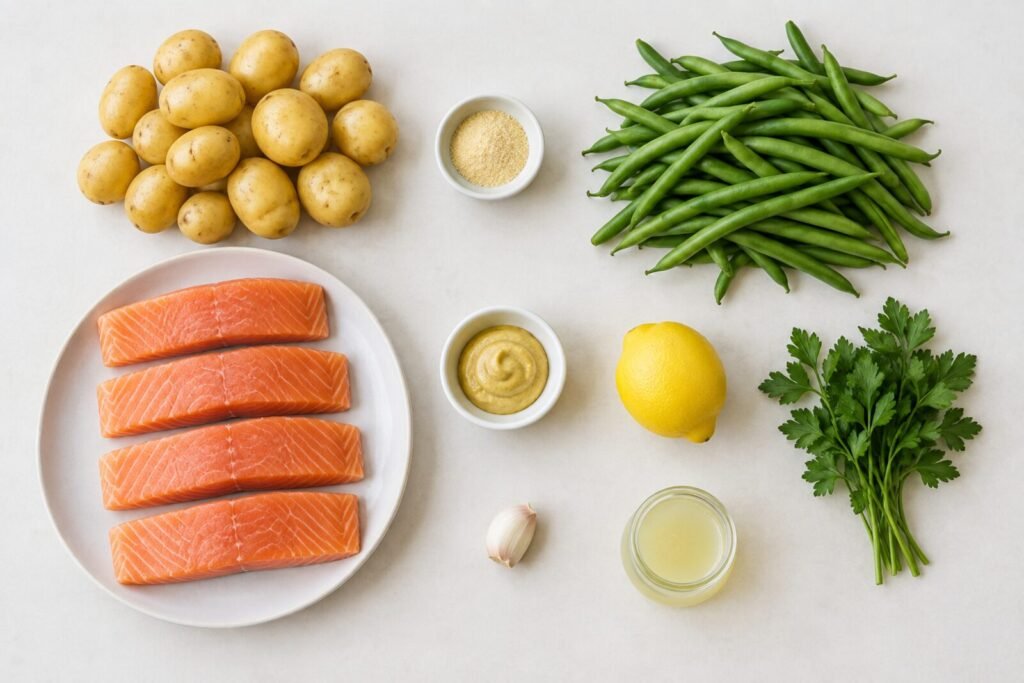
Skinless salmon fillets (four 5½ oz / 620 g). Center-cut, about 1 inch thick. Frozen portions thawed overnight in the fridge work the same. Baby potatoes (1 lb / 450 g). Yellow or red, about 1½ inches across, halved. Larger potatoes cut into 1½-inch chunks behave the same. Green beans (1 lb / 450 g). Trimmed at the stem end only; the tails can stay. Dijon mustard (1 tbsp / 15 g). It holds the lemon zest on the fish and keeps the top from drying out in the heat.
Scales every quantity and the servings count. The panel stays per serving.
1 lb(450 g) baby potatoes, halved
2 tsp(9 g) olive oil, divided
½ tsp(1.5 g) garlic powder
½ tsp(3 g) fine salt, divided
½ tsp(1 g) black pepper
1 lb(450 g) green beans, trimmed
4skinless salmon fillets, 5½ oz each (620 g total)
1 tbsp(15 g) Dijon mustard
1 tsp(2 g) lemon zest, for the salmon
½ cup(15 g) flat-leaf parsley, finely chopped
1garlic clove (3 g), minced
1 tsp(2 g) lemon zest, for the gremolata
1 tbsp(15 ml) lemon juice
Lemon wedges, optional
Method
Heat the oven to 425 °F (220 °C) with a rack in the lower-middle position. Line an 18 × 13-inch rimmed sheet pan with parchment if you like.
Toss the potatoes on the pan with 1 tsp of the oil, the garlic powder, ¼ tsp of the salt and the pepper. Turn them all cut side down.
Roast 20 minutes, without stirring, until the cut sides are golden and a knife meets only a little resistance.
Meanwhile, toss the green beans in a bowl with the remaining 1 tsp oil. Stir the Dijon and 1 tsp lemon zest together.
Pat the salmon dry and season with the remaining ¼ tsp salt.
Push the potatoes to the short ends of the pan. Spread the green beans in the middle and lay the salmon on top of them. Brush the fillets with the mustard.
Roast 10 to 13 minutes, until the salmon flakes at the thickest point and reads 145 °F (63 °C), and the beans are blistered in spots.
Stir the parsley, garlic, 1 tsp lemon zest and lemon juice together. Spoon the gremolata over the salmon and potatoes and serve with lemon wedges.
Cook’s note
Leaving the potatoes cut side down and untouched for the first 20 minutes is what browns them, and laying the fish on the beans keeps its underside from overcooking against the hot pan.
Storage
Refrigerate 3 days. Reheat the potatoes and beans in a 375 °F (190 °C) oven for 10 minutes, adding the salmon for the last 5, or eat the salmon cold. Does not freeze well; the potatoes turn grainy.
Nutrition
Nutrition Facts
4 servings per recipeServing size 1 of 4 servings
Calories per serving465
% Daily Value*
Total Fat 24g
31%
Saturated Fat 5g
25%
Sodium 440mg
19%
Total Carbohydrate 27g
10%
Dietary Fiber 6g
21%
Total Sugars 5g
Protein 36g
72%
* The % Daily Value tells you how much a nutrient in a serving of food contributes to a daily diet. 2,000 calories a day is used for general nutrition advice.
How this panel was built
Every ingredient in this recipe is mapped to a USDA FoodData Central entry and the panel is computed from those entries for one serving as written. Optional ingredients and anything "to taste" are excluded. Values are rounded: protein to the gram, calories to the nearest 5 and sodium to the nearest 10 mg. The panel is calculated, not lab-tested; a different brand of stock or cheese will move sodium and fat. Cost per serving is an estimate at national-average store-brand prices; your store will differ.