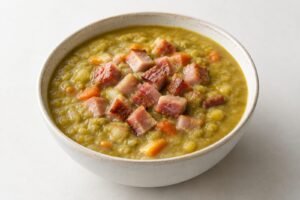
Split pea soup is traditionally built on a ham hock, which brings smoke and a lot of fat. We use a pack of diced extra-lean ham instead, in two halves: one half cooks with the peas all day and seasons the pot, the other is browned in a dry skillet at the end and stirred in, so there are still pieces with some chew. Smoked paprika covers the smoke the hock would have given.
Fifteen minutes of chopping, then 8 hours on low or 5 on high in a 6-quart cooker, with no soaking. There is no measured salt on purpose: the ham and stock bring enough, and how much varies by brand, so taste only after the browned ham goes in.
Why this one works
34 g protein per serving: 18 g from the split peas and 11 g from the ham, so neither has to do it alone.
18 g fiber per serving, 17 g of it from the split peas, which also thicken the soup, so there is no flour, cream or potato.
There is no added salt; the ham and stock season it, and the smaller-ham swap takes the soup from 820 mg to 580 mg sodium per serving.
It keeps 4 days and freezes 3 months, at $1.97 a serving.
Ingredient notes
Extra-lean diced ham (12 oz / 340 g). Sold diced in packs near the bacon. The ham supplies most of the salt in this pot, about 720 mg of the 820 mg sodium per serving with the ham we computed, and brands differ a lot, so compare labels; the swaps table has a smaller-ham row and a deli-turkey row. Green split peas (1 lb / 454 g). No soaking needed. Old peas take longer to break down, so buy from a shelf that turns over. Yellow split peas cook the same and taste milder. Low-sodium chicken stock (6 cups / 1440 ml). Regular stock on top of the ham makes the soup too salty to fix. Sherry vinegar (1 tbsp / 15 ml). One spoon at the end lifts a soup that otherwise tastes heavy. Cider vinegar works.
Scales every quantity and the servings count. The panel stays per serving.
1 lb(454 g) dried green split peas, rinsed and picked over
1medium yellow onion (150 g), diced
2medium carrots (120 g), diced
2celery ribs (80 g), diced
3garlic cloves (9 g), minced
12 oz(340 g) extra-lean diced ham, divided
1 tsp(1 g) dried thyme
1 tsp(2 g) smoked paprika
½ tsp(1 g) ground black pepper
2bay leaves (0.5 g)
6 cups(1,440 ml) low-sodium chicken stock
2 cups(480 ml) water
1 tbsp(15 ml) sherry vinegar
Fine salt, optional, to taste
Method
Put the split peas, onion, carrots, celery and garlic in a 6-quart slow cooker.
Add half the ham (170 g), the thyme, paprika, pepper and bay leaves. Refrigerate the other half.
Pour in the stock and water and stir.
Cover and cook on LOW for 8 hours or HIGH for 5 hours, until the peas have collapsed and the soup is thick.
Remove the bay leaves. Whisk hard for 30 seconds to break up the last whole peas.
Brown the reserved ham in a dry nonstick skillet over medium-high for 4 minutes, until the edges crisp.
Stir the browned ham and the vinegar into the soup. Serve once it is steaming, at least 165 °F (74 °C). Taste before adding any salt.
Cook’s note
Holding back half the ham and browning it at the end is what keeps the soup from being one texture; the slow-cooked half dissolves into the peas and seasons them.
Storage
Refrigerate 4 days or freeze 3 months. It sets almost solid in the fridge; reheat with ½ cup (120 ml) water per two servings, stirring, until it is back to 165 °F (74 °C).
Nutrition
Nutrition Facts
6 servings per recipeServing size 1 of 6 servings
Calories per serving405
% Daily Value*
Total Fat 7g
9%
Saturated Fat 1.5g
8%
Sodium 820mg
36%
Total Carbohydrate 55g
20%
Dietary Fiber 18g
64%
Total Sugars 5g
Protein 34g
68%
* The % Daily Value tells you how much a nutrient in a serving of food contributes to a daily diet. 2,000 calories a day is used for general nutrition advice.
How this panel was built
Every ingredient in this recipe is mapped to a USDA FoodData Central entry and the panel is computed from those entries for one serving as written. Optional ingredients and anything "to taste" are excluded. Values are rounded: protein to the gram, calories to the nearest 5 and sodium to the nearest 10 mg. The panel is calculated, not lab-tested; a different brand of stock or cheese will move sodium and fat. Cost per serving is an estimate at national-average store-brand prices; your store will differ.