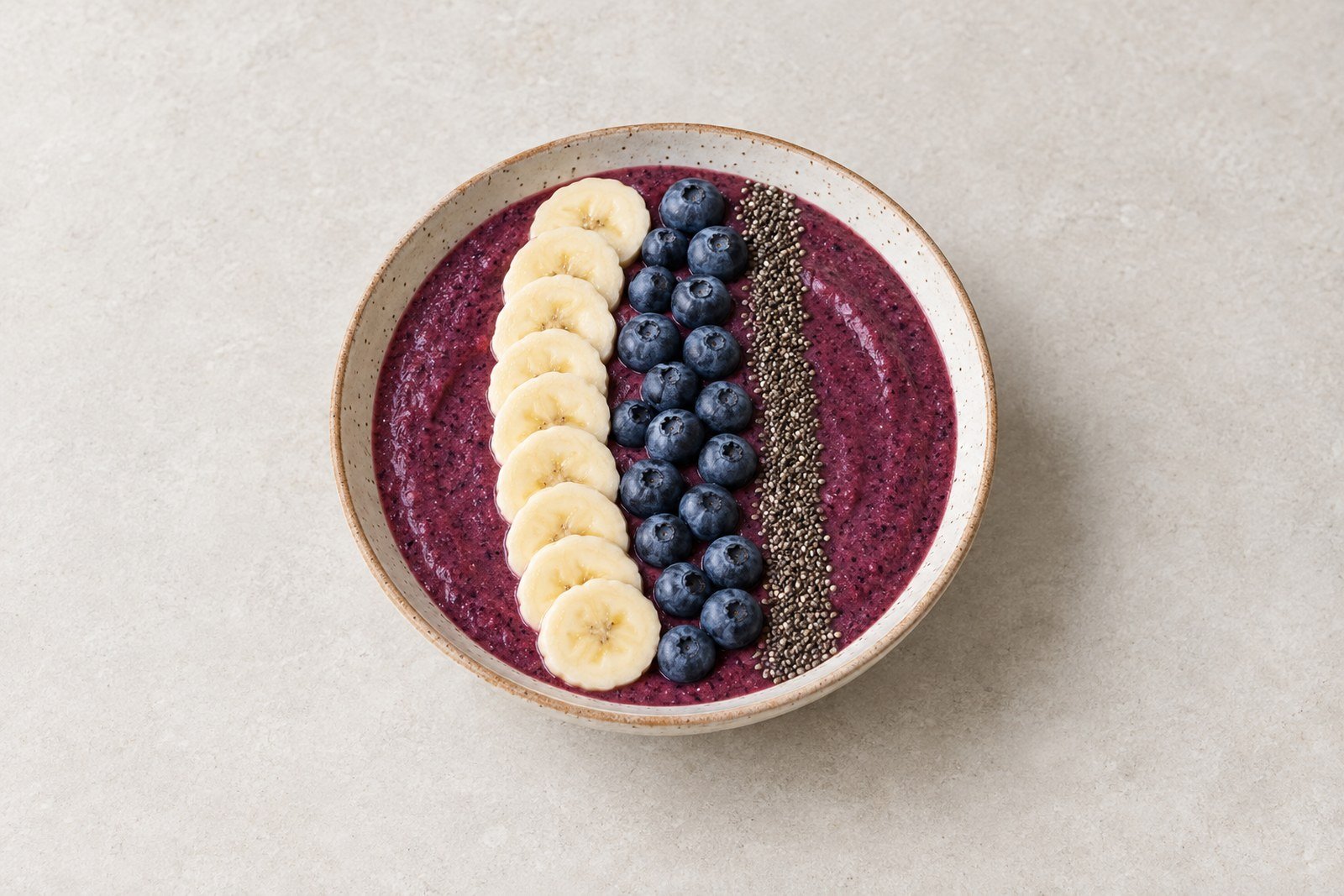
A thick, spoonable berry smoothie bowl whose protein comes from food: nonfat Greek yogurt and cottage cheese blended with frozen mixed berries, half a banana per bowl and only three tablespoons of milk. The cottage cheese disappears completely in the blender and makes the base creamier than yogurt alone. Keeping the liquid that low is what makes it a bowl rather than a drink, firm enough that the toppings sit on top instead of sinking.
Ten minutes, and a blender with a tamper helps; without one, stop and stir every 15 seconds. Use the berries straight from the freezer, because thawed berries give you a smoothie, not a bowl. A bag of mixed berries is cheaper than any single berry and the color comes out a deep purple. Chill the bowls in the freezer while you measure if you want it to stay thick longer.
Why this one works
Greek yogurt and cottage cheese together supply 29 g of the 33 g protein per bowl, from food, not powder.
Frozen fruit thickens the bowl, so there is no ice to water it down and only 3 tbsp of milk for both bowls.
Half a banana per bowl is the only sweetener, with no honey or juice, and it adds 45 kcal.
One blender jar and 10 minutes, with 30 g of blueberries and 1 tsp of chia per bowl on top.
Ingredient notes
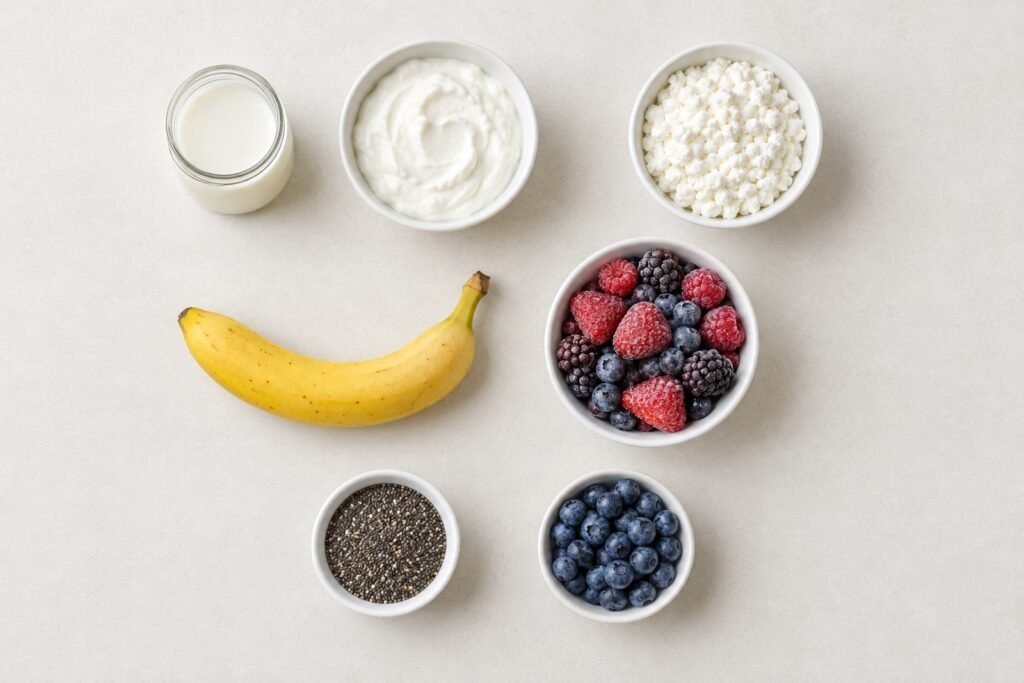
Nonfat Greek yogurt (1½ cups / 340 g). Nonfat leaves room for the cottage cheese and the fruit. Any thick strained yogurt works; regular yogurt makes the bowl too loose. Cottage cheese (2%, 1 cup / 226 g). It blends to nothing and adds body, plus 12 g protein and 350 mg of the 420 mg sodium per bowl. Low-sodium cottage cheese works the same and takes off 330 mg. Frozen mixed berries (2 cups / 280 g). Any frozen mix of strawberries, blueberries, raspberries and blackberries. USDA has no unsweetened mixed-berry entry, so we compute the mix as frozen blackberries, which carry more fiber than most berries: the frozen-strawberry swap shows 4 g less fiber per bowl, so read the fiber figure as a high estimate. Milk (2%, 3 tbsp / 45 ml). Start with this much and add more a tablespoon at a time only if the blender stalls. Every extra spoonful thins the bowl.
Scales every quantity and the servings count. The panel stays per serving.
3 tbsp(45 ml) 2% milk
1½ cups(340 g) nonfat Greek yogurt
1 cup(226 g) 2% cottage cheese
1medium ripe banana (100 g), half sliced for the top
2 cups(280 g) frozen mixed berries
2 tsp(8 g) chia seeds
½ cup(60 g) fresh blueberries
Method
Put the milk, yogurt and cottage cheese in the blender jar first, then half the banana, broken into pieces, then the frozen berries on top.
Blend on low for 15 seconds, pressing the berries down with the tamper, then on high for 30 to 45 seconds until thick and smooth.
Check the texture: it should mound on a spoon. If the blender stalls, add 1 tbsp milk and blend again.
Spoon into two chilled bowls and smooth the tops with the back of the spoon.
Slice the remaining half banana into coins and arrange them with the blueberries and chia in rows over each bowl. Eat right away.
Cook’s note
Liquids in the jar first and frozen fruit on top lets the blades catch, so the bowl blends with a few tablespoons of milk instead of the cup most smoothie recipes need.
Storage
Best eaten within 10 minutes. Leftover base can be frozen in a lidded container up to 1 month; thaw 20 minutes on the counter and stir, and it eats like soft-serve. It does not hold in the fridge.
Nutrition
Nutrition Facts
2 servings per recipeServing size 1 of 2 servings
Calories per serving375
% Daily Value*
Total Fat 6g
8%
Saturated Fat 2g
10%
Sodium 420mg
18%
Total Carbohydrate 52g
19%
Dietary Fiber 10g
36%
Total Sugars 35g
Protein 33g
66%
* The % Daily Value tells you how much a nutrient in a serving of food contributes to a daily diet. 2,000 calories a day is used for general nutrition advice.
How this panel was built
Every ingredient in this recipe is mapped to a USDA FoodData Central entry and the panel is computed from those entries for one serving as written. Optional ingredients and anything "to taste" are excluded. Values are rounded: protein to the gram, calories to the nearest 5 and sodium to the nearest 10 mg. The panel is calculated, not lab-tested; a different brand of stock or cheese will move sodium and fat. Cost per serving is an estimate at national-average store-brand prices; your store will differ.