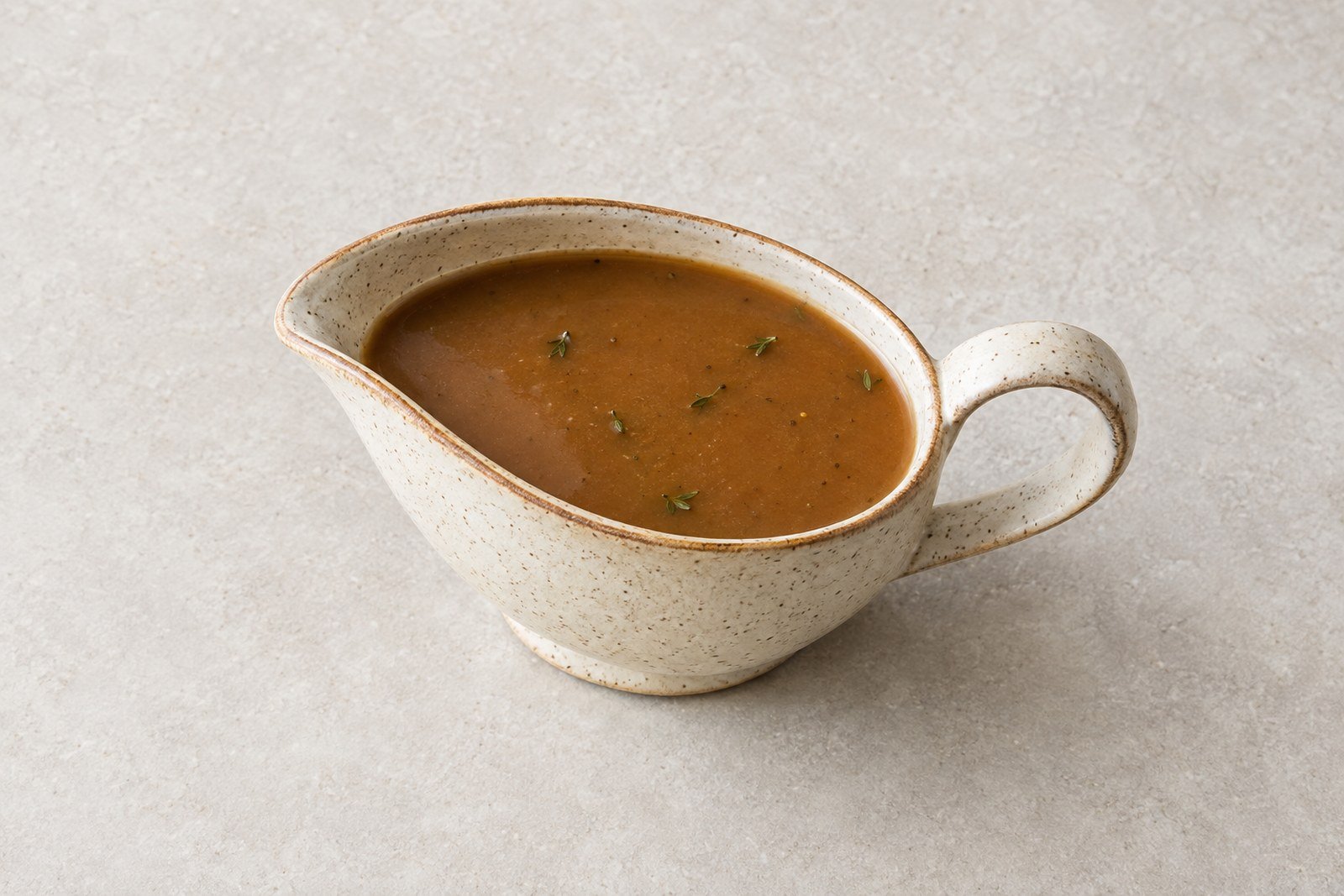
Turkey gravy is the sauce that ties the Thanksgiving plate together, and a good one starts in the roasting pan. This is a classic roux gravy: the fat skimmed off the drippings is cooked with flour, then whisked into the pan juices and low-sodium turkey stock and simmered until it coats a spoon. It makes about 4 cups, enough for 16 servings of ¼ cup.
About 20 minutes, made while the turkey rests. It works with the drippings from a whole turkey or a roast turkey breast; a breast gives less fat and juice, so make up the fat with a little neutral oil and the liquid with stock. The numbers count the pan juices as low-sodium stock with no added salt. Drippings from a brined or heavily salted bird bring more sodium, so taste before you salt.
Why this one works
A classic roux of skimmed turkey fat and flour, cooked until golden: about 30 of the 45 calories and 3 g of the 3.5 g fat per quarter cup come from the fat.
Pan juices topped up with low-sodium turkey stock: 20 mg sodium per quarter cup before you salt; drippings from a brined bird add more.
Flour thickens it, with no cream: 3 g carbohydrate and 0 g sugars per quarter cup.
The fat and juices come with the turkey, so the stock is the only real cost: $0.16 a serving.
Ingredient notes
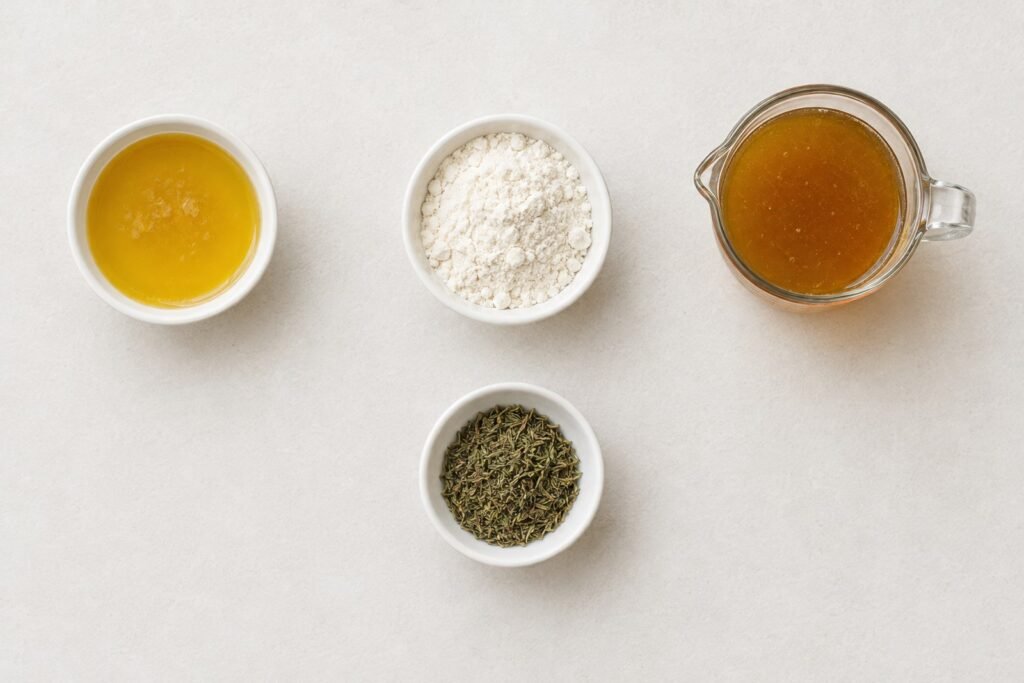
Turkey fat (¼ cup / 50 g). Skimmed from the top of the drippings. If the pan gives you less, make up the difference with a neutral oil such as canola; the numbers barely change. All-purpose flour (⅓ cup / 42 g). Cooked in the fat for a few minutes first, so the gravy tastes toasty rather than floury. Pan juices and low-sodium turkey stock (4 cups / 960 ml in all). Use every bit of the defatted juices and make up the rest with stock. Unsalted or low-sodium chicken stock works too; brands vary a lot in sodium, so check the label. Dried thyme (½ tsp). Or 1 tsp chopped fresh sage or thyme.
Scales every quantity and the servings count. The panel stays per serving.
¼ cup(50 g) turkey fat skimmed from the roasting-pan drippings (top up with neutral oil if short)
⅓ cup(42 g) all-purpose flour
4 cups(960 ml) defatted pan juices plus low-sodium turkey stock to make up the amount
½ tsp(0.5 g) dried thyme
¼ tsp(0.6 g) black pepper
Fine salt, to taste
Method
Pour the drippings from the roasting pan into a fat separator or a heatproof 4-cup glass measuring cup and let stand 5 minutes, until the fat rises to the top. Spoon ¼ cup of the fat into a medium saucepan, topping it up with oil if there isn't enough.
If your roasting pan is stovetop-safe, set it over medium heat, add 1 cup of the stock and scrape up the browned bits as it bubbles, about 2 minutes. Pour this into the defatted juices, then add stock to make 4 cups.
Heat the fat in the saucepan over medium heat. Whisk in the flour and cook, whisking constantly, 2 to 3 minutes, until the roux is smooth and light golden brown.
Slowly whisk in the liquid about 1 cup at a time, whisking out any lumps before adding more. Add the thyme and pepper.
Bring to a boil, then simmer, whisking often, 5 to 8 minutes, until the gravy coats the back of a spoon. Taste and add salt only if it needs it. For a perfectly smooth gravy, pour it through a fine sieve. Serve hot.
Cook’s note
Add the liquid slowly at first. The first cup makes a thick paste; whisk it smooth before the next goes in and the gravy won't go lumpy. If it gets too thick as it stands, whisk in a splash of stock.
Storage
Gravy keeps for less time than most leftovers: refrigerate within 2 hours, up to 2 days, and reheat to a boil, whisking. It freezes up to 3 months; whisk well as it reheats.
Nutrition
Nutrition Facts
16 servings per recipeServing size ¼ cup gravy
Calories per serving45
% Daily Value*
Total Fat 3.5g
4%
Saturated Fat 1g
5%
Sodium 20mg
1%
Total Carbohydrate 3g
1%
Dietary Fiber 0g
0%
Total Sugars 0g
Protein 1g
2%
* The % Daily Value tells you how much a nutrient in a serving of food contributes to a daily diet. 2,000 calories a day is used for general nutrition advice.
How this panel was built
Every ingredient in this recipe is mapped to a USDA FoodData Central entry and the panel is computed from those entries for one serving as written. Optional ingredients and anything "to taste" are excluded. Values are rounded: protein to the gram, calories to the nearest 5 and sodium to the nearest 10 mg. The panel is calculated, not lab-tested; a different brand of stock or cheese will move sodium and fat. Cost per serving is an estimate at national-average store-brand prices; your store will differ.