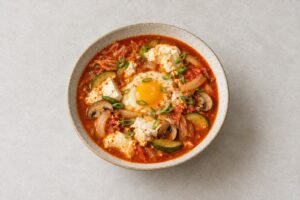
Sundubu jjigae is the Korean stew of silken tofu in a spicy red broth, brought to the table still bubbling with an egg cracked in at the last minute. Ours is meatless: gochugaru bloomed in a little oil, sour kimchi, mushrooms and zucchini, low-sodium vegetable broth in place of anchovy stock, a full box of silken tofu per bowl and one egg each. The tofu goes in last, spooned in large curds, so it stays custard-soft.
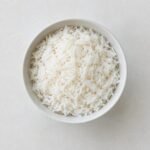
A 3-quart pot or a Korean earthenware pot and 25 minutes. Look for gochugaru, the Korean chili flakes, and well-fermented kimchi at a Korean market or the international aisle; sour, older kimchi gives the broth more depth. The boxed shelf-stable silken tofu works, and Korean grocers sell an even softer version in tubes. Serve it straight from the heat with rice.
Why this one works
A full box of silken tofu and an egg in each bowl carry the protein with no meat: 24 g per bowl from the tofu and 6 g from the egg.
The chili oil is two teaspoons of oil in all, and the gochugaru, kimchi and mushrooms bring the flavor: 20 g fat per bowl, about half of it from the tofu.
Low-sodium broth and soy sauce leave room for the kimchi, the largest single source of salt: 800 mg sodium per bowl, 270 mg of it from the kimchi.
15 minutes on the heat from cold pot to bubbling stew, at $5.28 a serving, $2.30 of it for the tofu.
Ingredient notes
Silken tofu (two 12.3 oz packages / 700 g). Spoon it in large pieces rather than cubing it; the rough curds soak up the broth. A Korean sundubu tube is softer still and works the same way. Gochugaru (1½ tbsp / 9 g). Sun-dried Korean chili flakes, bright red and fruity, much milder than crushed red pepper, so do not swap one for the other at the same amount. Buying note: sold in bags at Korean markets and larger grocers; it keeps for months in the freezer. Kimchi (¾ cup / 110 g, chopped). Napa cabbage kimchi that has turned sour gives the broth its depth. Buying note: refrigerated aisle; buy it a week or two ahead or use the oldest jar in the fridge. It brings 270 mg sodium per bowl; ½ cup instead of ¾ takes off 90 mg. Large eggs (2 / 100 g). Cracked into the stew at the end and cooked by its heat; the yolk stays runny and thickens the broth as you stir it in. Low-sodium vegetable broth (2 cups / 480 ml). Stands in for the anchovy and kelp stock most Korean cooks use, which keeps the stew meatless.
Scales every quantity and the servings count. The panel stays per serving.
1 tsp(4.5 g) canola oil
1 tsp(4.5 g) toasted sesame oil
3scallions (45 g), whites minced and greens sliced, kept separate
3garlic cloves (9 g), minced
½small yellow onion (60 g), thinly sliced
1½ tbsp(9 g) gochugaru (Korean chili flakes)
¾ cup(110 g) kimchi, chopped
2 cups(480 ml) low-sodium vegetable broth
2 tsp(10 ml) low-sodium soy sauce
4 oz(115 g) cremini mushrooms, sliced
½small zucchini (80 g), cut into half-moons
212.3 oz packages silken tofu (700 g)
2large eggs (100 g)
Method
Heat the canola and sesame oils in a 3-quart pot or earthenware pot over medium-low. Add the scallion whites, garlic and onion and cook 2 minutes, until soft and fragrant but not browned.
Stir in the gochugaru and cook 30 seconds, stirring, until the oil turns brick red. Watch it closely; chili flakes scorch fast.
Add the kimchi and cook 2 minutes, stirring, until it softens and its edges look glossy.
Add the broth, soy sauce, mushrooms and zucchini. Bring to a boil over medium-high, then simmer 4 minutes.
Spoon the tofu into the pot in large pieces. Simmer 4 minutes, nudging gently with the spoon rather than stirring, until the tofu is hot through.
Make two wells in the stew and crack an egg into each. Cover and cook 2 to 3 minutes, until the whites are just set and the yolks still runny.
Scatter the scallion greens over the top and serve straight from the heat.
Cook’s note
Blooming the gochugaru in the oil for 30 seconds before any liquid goes in is the technique: it turns the oil red and gives the broth its toasted chili flavor; added straight to the broth, the flakes taste raw.
Storage
Best eaten right away. The broth without tofu or eggs keeps 3 days in the fridge; bring it back to a boil and add fresh tofu and eggs. Once the tofu and eggs are in, it does not hold or freeze well; the tofu weeps water and the eggs overcook.
Nutrition
Nutrition Facts
2 servings per recipeServing size 1 of 2 servings
Calories per serving410
% Daily Value*
Total Fat 20g
26%
Saturated Fat 3.5g
18%
Sodium 800mg
35%
Total Carbohydrate 26g
9%
Dietary Fiber 4.5g
16%
Total Sugars 12g
Protein 35g
70%
* The % Daily Value tells you how much a nutrient in a serving of food contributes to a daily diet. 2,000 calories a day is used for general nutrition advice.
How this panel was built
Every ingredient in this recipe is mapped to a USDA FoodData Central entry and the panel is computed from those entries for one serving as written. Optional ingredients and anything "to taste" are excluded. Values are rounded: protein to the gram, calories to the nearest 5 and sodium to the nearest 10 mg. The panel is calculated, not lab-tested; a different brand of stock or cheese will move sodium and fat. Cost per serving is an estimate at national-average store-brand prices; your store will differ.