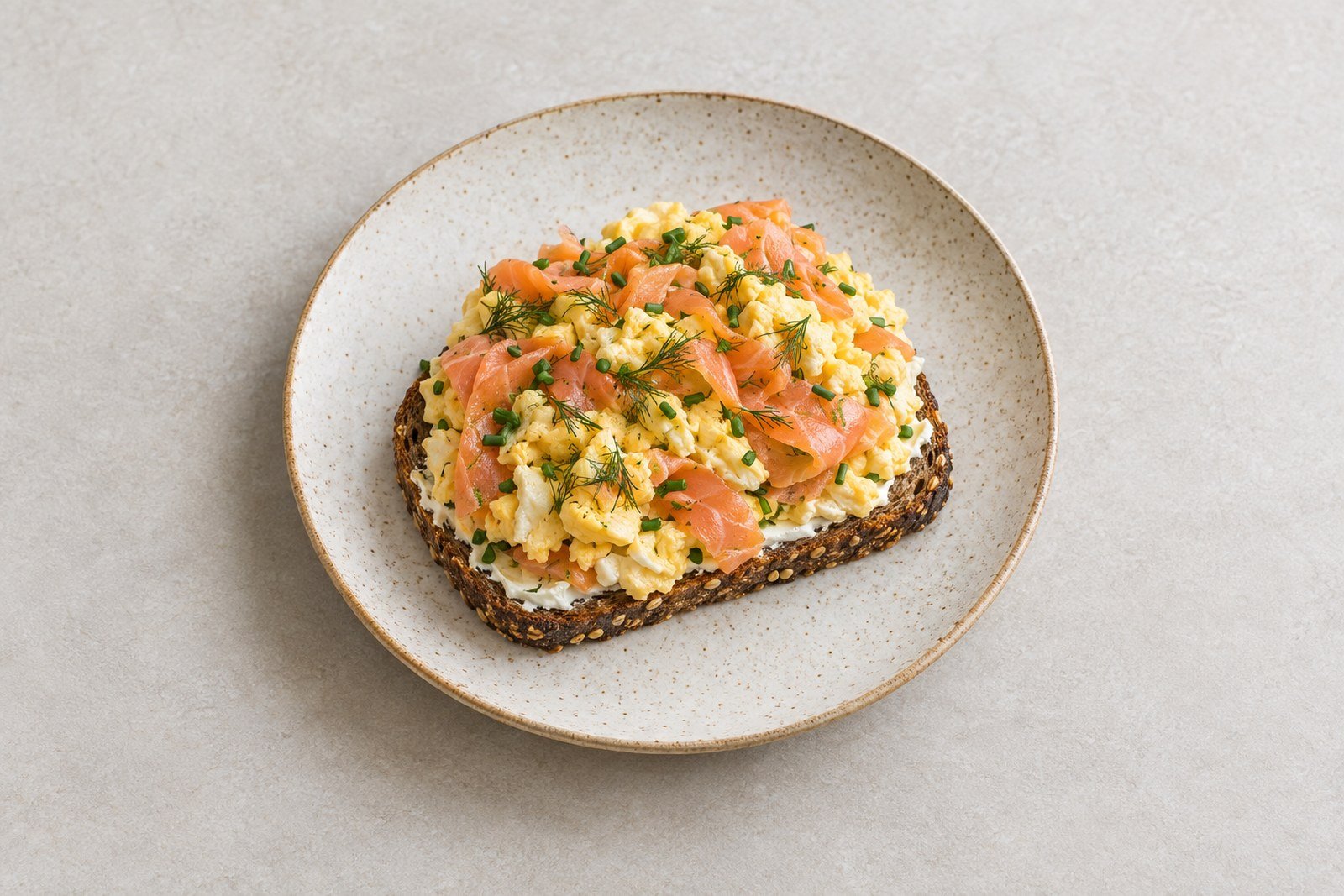
Soft-scrambled eggs cooked low and slow with a spatula until they form small, glossy curds, then pulled off the heat while still loose so torn smoked salmon can warm through in the pan without cooking. Whole eggs plus egg whites make a bigger scramble without losing the custardy texture, and a thin layer of Neufchâtel on dark rye stands in for the bagel and cream cheese. Chives and dill finish it.
Under 15 minutes in a 10-inch nonstick skillet over medium-low heat; the low heat is the whole method. Buy cold-smoked salmon (lox-style), which is silky and sliced thin, not hot-smoked, which flakes. It is salty enough that the eggs get no salt at all. A dense seeded rye or pumpernickel holds the eggs better than a light deli rye.
Why this one works
Four whole eggs, ½ cup of egg whites and 4 oz of smoked salmon across two plates: 34 g protein per serving, 19 g from the eggs and whites and 10 g from the salmon.
The salmon goes in off the heat, so it stays silky and the eggs need no added salt; it still brings 380 of the 870 mg sodium per serving.
A teaspoon of butter per plate and a splash of milk keep the curds soft, with no cream; the butter adds 30 kcal per serving.
The whole thing is on the plate in under 15 minutes; at $4.44 a serving, $2.99 of it is the salmon.
Ingredient notes
Smoked salmon (4 oz / 113 g). Cold-smoked, sliced thin, torn into strips. It is the largest share of the sodium and the cost, 380 mg and $2.99 per serving; the half-salmon swap with two more eggs takes off 120 mg sodium and $1.29. Seeded rye bread (2 slices / 64 g). Dense, dark rye or pumpernickel. We computed it as FoodData Central's rye bread. Whole-grain bread is the closest swap. Liquid egg whites (½ cup / 120 g). From a carton. Whisked with the whole eggs, they scramble the same way. Neufchâtel (2 tbsp / 28 g). The softer cousin of cream cheese, sold beside it; cream cheese in its place adds 15 kcal and 1.5 g fat per serving. Spread thin on the hot toast.
Scales every quantity and the servings count. The panel stays per serving.
2 slices(64 g) seeded rye bread
2 tbsp(28 g) Neufchâtel
4large eggs (200 g)
½ cup(120 g) liquid egg whites
2 tbsp(30 g) 2% milk
2 tsp(9 g) unsalted butter
4 oz(113 g) smoked salmon, torn into strips
1 tbsp(3 g) chopped chives
1 tbsp(3 g) chopped dill
¼ tsp(0.5 g) black pepper
Lemon wedges and capers, optional
Method
Toast the rye and spread each slice thinly with Neufchâtel. Set on plates.
Whisk the eggs, egg whites, milk and pepper in a bowl for 30 seconds, until no streaks of white remain.
Melt the butter in a 10-inch nonstick skillet over medium-low until it foams but does not brown.
Pour in the eggs. Wait 20 seconds, then push them slowly from the edge to the center with a silicone spatula, over and over, for 3 to 4 minutes.
Take the pan off the heat while the curds are still glossy and slightly wet. Fold in the salmon, half the chives and half the dill; the eggs finish in the pan's heat.
Pile the eggs on the toast and top with the rest of the chives and dill.
Cook’s note
Take the eggs off the heat a moment before they look done; they keep cooking for about a minute in the pan and on the plate, and the salmon needs that time to warm.
Storage
Best eaten right away; scrambled eggs turn rubbery when reheated. Opened smoked salmon keeps 3 days in the fridge, wrapped tight. Does not freeze.
Nutrition
Nutrition Facts
2 servings per recipeServing size 1 of 2 servings
Calories per serving400
% Daily Value*
Total Fat 20g
26%
Saturated Fat 8g
40%
Sodium 870mg
38%
Total Carbohydrate 18g
7%
Dietary Fiber 2g
7%
Total Sugars 3.5g
Protein 34g
68%
* The % Daily Value tells you how much a nutrient in a serving of food contributes to a daily diet. 2,000 calories a day is used for general nutrition advice.
How this panel was built
Every ingredient in this recipe is mapped to a USDA FoodData Central entry and the panel is computed from those entries for one serving as written. Optional ingredients and anything "to taste" are excluded. Values are rounded: protein to the gram, calories to the nearest 5 and sodium to the nearest 10 mg. The panel is calculated, not lab-tested; a different brand of stock or cheese will move sodium and fat. Cost per serving is an estimate at national-average store-brand prices; your store will differ.