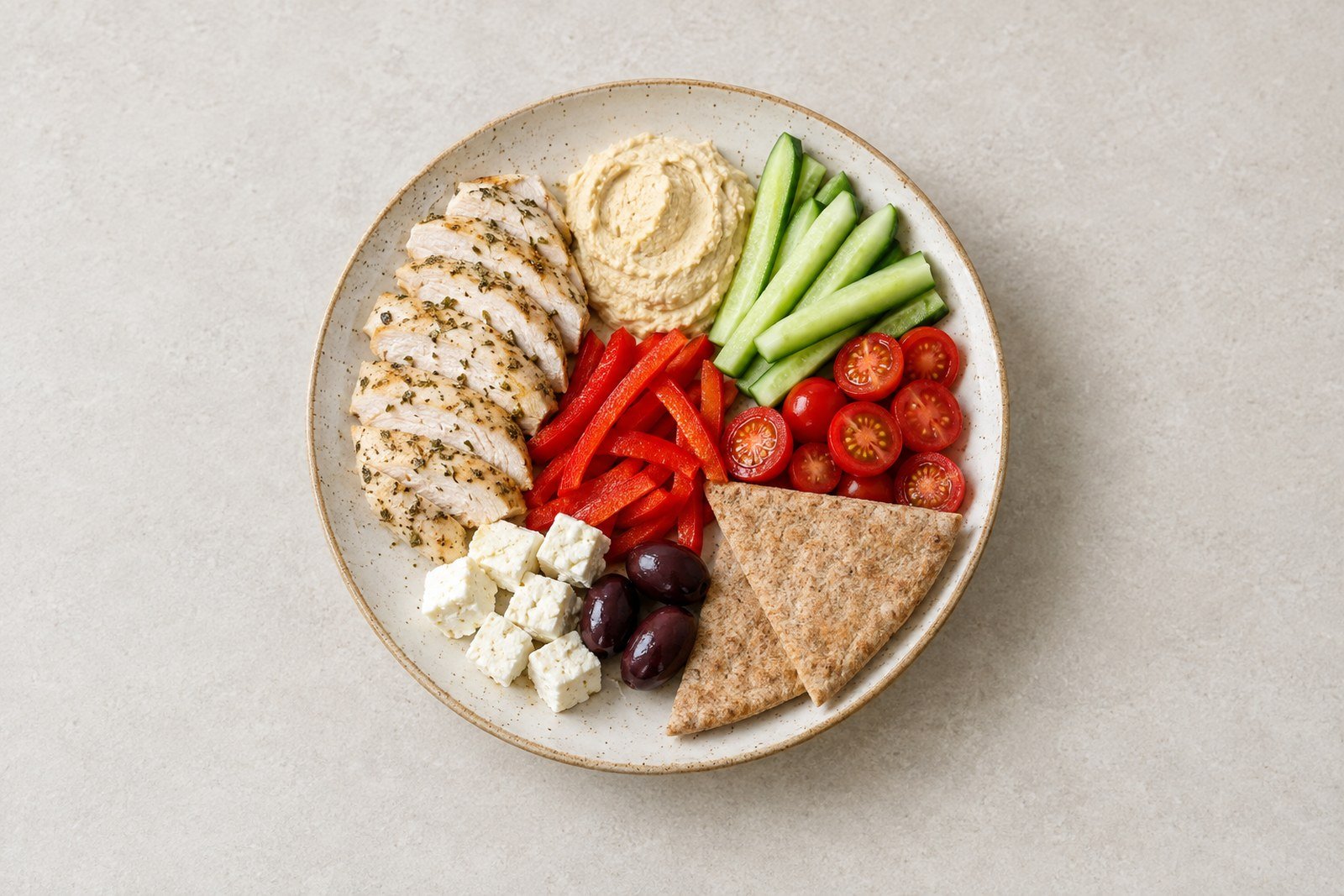
A desk lunch built like a mezze plate: sliced chicken breast tossed in lemon and oregano, a scoop of hummus, crisp vegetables cut for dipping, a few cubes of feta and olives, and two wedges of whole-wheat pita. Nothing in it needs a microwave, and every part holds its texture until noon on day four because the wet and dry components sit in separate compartments.
Twenty minutes with a knife and a board, using chicken you already cooked: weekend leftovers, a store rotisserie breast with the skin pulled off, or a batch poached on Sunday. We weigh the chicken cooked, so the recipe works whichever way you got there. Buy divided containers with three or four sections; the hummus needs its own corner or the pita goes soft.
Why this one works
The chicken is weighed cooked, so the panel holds whether it was poached, grilled or roasted; it supplies 39 g of the 49 g protein per box.
Hummus and pita bring the starch and a second protein source, about 7 g protein and 4.5 g fiber from the pair, with no dressing beyond lemon.
The salty foods are counted by the piece, three olives and a quarter of the feta per box: 830 mg sodium per serving, about 300 mg of it from those two.
It holds 4 days in the fridge with no reheating, which is the whole point of a desk lunch, at $4.07 a serving.
Ingredient notes
Cooked chicken breast (about 3 cups / 480 g). Skinless, sliced or cubed. About 1½ lb (680 g) raw boneless skinless breast cooks down to this. Poach it in barely simmering water for 15 minutes, until it reads 165 °F (74 °C), and cool before slicing. Our pantry note on poaching chicken breast has the method. Hummus (¾ cup / 180 g). Any plain store-bought tub. Flavored ones (roasted red pepper, garlic) work the same; skip the ones with a pool of oil on top. Kalamata olives (12 pitted / 40 g). Pitted saves you a mess at your desk. Three per box is enough to taste them in every bite of chicken; they add about 130 mg sodium per box, and the swaps table has a one-olive row. Feta (2 oz / 60 g). Buy it in a block packed in brine and cube it; pre-crumbled feta dries out and goes chalky in the fridge. Whole-wheat pitas (2 / 128 g). The 6½-inch size, cut into quarters. Pack them in the dry compartment, away from the tomatoes.
Scales every quantity and the servings count. The panel stays per serving.
3 cups(480 g) cooked chicken breast, sliced
1 tbsp(15 g) lemon juice
1 tsp(1 g) dried oregano
¼ tsp(1.5 g) fine salt
¼ tsp(0.5 g) black pepper
¾ cup(180 g) hummus
1English cucumber (300 g), cut into spears
1 pint(300 g) cherry tomatoes, halved
1medium red bell pepper (180 g), cut into strips
2 oz(60 g) feta, cut into ½-inch cubes
12pitted kalamata olives (40 g)
2whole-wheat pitas (128 g), each cut into 4 wedges
Method
Toss the chicken in a bowl with the lemon juice, oregano, salt and pepper until every piece is coated.
Spoon 3 tablespoons of hummus into the smallest compartment of each of 4 containers.
Divide the chicken among the largest compartments.
Fill the remaining space with the cucumber, tomatoes and bell pepper, then tuck 3 olives and a quarter of the feta beside the chicken.
Wrap 2 pita wedges per box in a square of parchment and lay them on top of the dry vegetables, away from the tomatoes.
Close the lids and refrigerate.
Cook’s note
Pack the halved tomatoes cut side down against the cucumber, as far from the pita and hummus as the box allows; their juice is what turns day four soggy, and the cucumber does not mind it.
Storage
Refrigerate up to 4 days. Does not freeze. Eat it cold or let it sit out 15 minutes; the chicken and hummus taste better a little warmer than fridge temperature.
Nutrition
Nutrition Facts
4 servings per recipeServing size 1 of 4 servings
Calories per serving485
% Daily Value*
Total Fat 19g
24%
Saturated Fat 5g
25%
Sodium 830mg
36%
Total Carbohydrate 35g
13%
Dietary Fiber 7g
25%
Total Sugars 6g
Protein 49g
98%
* The % Daily Value tells you how much a nutrient in a serving of food contributes to a daily diet. 2,000 calories a day is used for general nutrition advice.
How this panel was built
Every ingredient in this recipe is mapped to a USDA FoodData Central entry and the panel is computed from those entries for one serving as written. Optional ingredients and anything "to taste" are excluded. Values are rounded: protein to the gram, calories to the nearest 5 and sodium to the nearest 10 mg. The panel is calculated, not lab-tested; a different brand of stock or cheese will move sodium and fat. Cost per serving is an estimate at national-average store-brand prices; your store will differ.