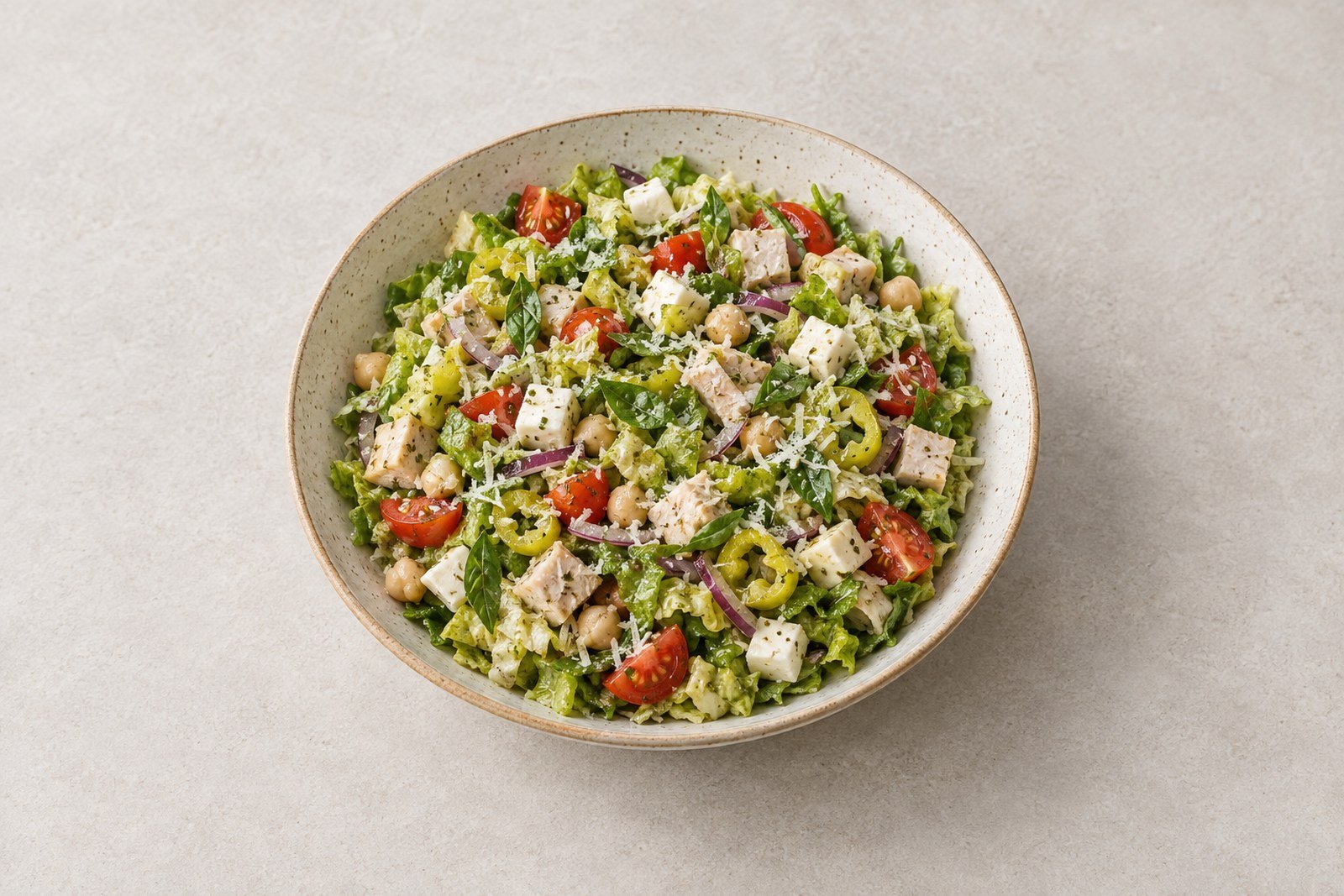
An Italian-American chopped salad, where everything is cut to the size of a chickpea so each forkful has some of everything: roast turkey breast, chickpeas, mozzarella, tomatoes, pepperoncini and red onion through finely chopped romaine, in an oregano and red wine vinaigrette with Parmesan. We use turkey breast in place of the usual salami to keep the sodium in check, and part-skim mozzarella in place of provolone.
No cooking, 25 minutes of chopping, one big bowl. Buy or roast turkey breast in a single thick piece; leftover home-roasted breast is what we computed. A ½-inch slab of lower-sodium roast turkey from the deli counter dices just as well; the swaps table shows what it changes. Thin deli slices will not dice. Packed in jars with the dressing at the bottom and the romaine on top, it holds three days.
Why this one works
49 g protein per serving: 33 g from the roast turkey breast, 7 g from the mozzarella and 4 g from the chickpeas, with Parmesan adding the rest.
Home-roasted turkey breast stands in for salami and adds 130 mg sodium per serving; the same weight of lower-sodium deli turkey would add 530 mg more.
No added salt: the pepperoncini, mozzarella and Parmesan season it and bring 520 mg of the 670 mg sodium per serving.
No cooking, just 25 minutes with a knife and one bowl, at $3.91 a serving.
Ingredient notes
Roast turkey breast, in one piece (1 lb / 450 g). We computed home-roasted breast, meat only: 33 g protein and 130 mg sodium per serving. A lower-sodium oven-roasted breast from the deli counter, asked for as a single ½-inch-thick slab, works too, at 15 g less protein and 530 mg more sodium per serving. Avoid thin-sliced packaged deli turkey: it shreds instead of dicing. Part-skim mozzarella (4 oz / 113 g). The low-moisture block, not fresh balls in water; it dices cleanly and does not weep. Provolone is the classic choice and is in the swaps. Pepperoncini (6 / 60 g). Mild, vinegary pickled peppers in a jar. They give the salad its sharp edge and the largest share of its sodium, 250 mg per serving; leaving them out for a little more vinegar is in the swaps. No-salt-added chickpeas (one 15 oz can / 240 g drained). Rinse and drain well, then let them sit in the dressing while you chop so they take it up.
Scales every quantity and the servings count. The panel stays per serving.
3 tbsp(45 ml) red wine vinegar
1 tsp(5 g) Dijon mustard
1garlic clove (3 g), grated
1 tsp(1 g) dried oregano
¼ tsp(0.5 g) red pepper flakes
¼ tsp(0.5 g) black pepper
2 tbsp(27 g) olive oil
115 oz can no-salt-added chickpeas (240 g drained), rinsed
¼small red onion (40 g), thinly sliced
2romaine hearts (300 g), finely chopped
1 lb(450 g) roast turkey breast in one piece, cut into ½-inch dice
4 oz(113 g) low-moisture part-skim mozzarella, cut into ½-inch dice
1½ cups(225 g) cherry tomatoes, quartered
6pepperoncini (60 g), stemmed and sliced
1 oz(28 g) Parmesan, finely grated
¼ cup(6 g) basil leaves, torn
Method
Whisk the vinegar, Dijon, garlic, oregano, pepper flakes and black pepper in a large bowl. Whisk in the oil in a thin stream.
Add the chickpeas and onion to the dressing and stir. Let them sit while you chop the rest.
Chop the romaine into pieces about ½ inch across, close to the size of a chickpea.
Add the turkey, mozzarella, tomatoes and pepperoncini to the bowl and stir to coat.
Add the romaine, Parmesan and basil and toss for 30 seconds, until every leaf is glossy.
Cook’s note
Cutting everything, lettuce included, to the same small size is the technique: the salad mixes evenly and every forkful carries turkey, cheese and chickpeas instead of a mouthful of plain lettuce.
Storage
Refrigerate up to 3 days packed in jars or containers in layers: dressing, chickpeas and onion at the bottom, then turkey, cheese and tomatoes, with the romaine and basil on top. Shake or toss to mix. Does not freeze.
Nutrition
Nutrition Facts
4 servings per recipeServing size 1 of 4 servings
Calories per serving445
% Daily Value*
Total Fat 18g
23%
Saturated Fat 6g
30%
Sodium 670mg
29%
Total Carbohydrate 23g
8%
Dietary Fiber 7g
25%
Total Sugars 6g
Protein 49g
98%
* The % Daily Value tells you how much a nutrient in a serving of food contributes to a daily diet. 2,000 calories a day is used for general nutrition advice.
How this panel was built
Every ingredient in this recipe is mapped to a USDA FoodData Central entry and the panel is computed from those entries for one serving as written. Optional ingredients and anything "to taste" are excluded. Values are rounded: protein to the gram, calories to the nearest 5 and sodium to the nearest 10 mg. The panel is calculated, not lab-tested; a different brand of stock or cheese will move sodium and fat. Cost per serving is an estimate at national-average store-brand prices; your store will differ.