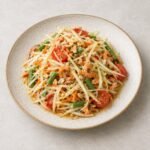
Gyeran-jjim is the Korean steamed egg that comes to the table still puffing over the rim of its pot, soft as custard inside. Ours is the stovetop version: eggs beaten into a quick stock of dried anchovies and kelp, stirred over the heat until they turn to soft curds, then covered on low until they rise. The stock gives the eggs their savory depth, so the only other seasoning is a little salt and scallion.
A 1-quart Korean earthenware pot (ttukbaegi) is traditional and holds the heat, but a small heavy saucepan works; the stock is made in the same pot. Large dried anchovies for stock and squares of dried kelp are sold in bags at Korean markets and keep for months in the freezer. It takes 25 minutes, most of it the stock, and it is meant to be eaten as soon as it comes off the heat, before it settles.
Why this one works
Six eggs for four servings are the protein: 9 g of the 10 g per serving.
The anchovy-kelp stock does the seasoning, so the only salt is ½ tsp: 290 mg of the 400 mg sodium per serving, with the eggs carrying the rest.
No oil goes in the pot: the 7 g fat per serving is the eggs' own.
25 minutes, most of it the stock, at $0.37 a serving.
Ingredient notes
Large dried anchovies (6 / 12 g). The large ones sold for stock, not the tiny ones for stir-frying. Pull off the heads and the dark gut along the belly, which turn the stock bitter. They are strained out, and we count the stock at zero, which leaves out the small amount of salt it picks up from them. Dried kelp (kombu, one 3-inch square / 3 g). Wipe off any grit but keep the white powder on the surface; it carries flavor. It comes out of the pot with the anchovies. Large eggs (6 / 300 g). Beat them until no streaks of white remain, about 30 seconds, so the custard sets evenly. Fine salt (½ tsp / 3 g). Many Korean cooks season with salted shrimp (saeujeot) instead; the swaps table has it.
Put the anchovies in a 1-quart earthenware pot or small heavy saucepan over medium and toast 1 minute, stirring, until fragrant.
Add the water and kelp and bring to a boil. Lower the heat and simmer 10 minutes.
Strain the stock into a measuring cup and discard the anchovies and kelp. You should have about 1¼ cups (300 ml); top up with water if needed. Wipe out the pot.
Beat the eggs, salt and half the scallions in a bowl until smooth and no streaks of white remain, about 30 seconds.
Pour the stock back into the pot and bring to a boil over medium-high. Pour in the eggs and stir constantly, scraping the bottom and sides, 1 to 2 minutes, until they thicken into soft, loose curds.
Turn the heat to low, scatter the remaining scallions over and cover with the lid or an upturned heatproof bowl. Cook 4 to 5 minutes, until the eggs puff up and the center is set when pressed.
Sprinkle with the sesame seeds and the gochugaru, if using, and serve straight from the pot.
Cook’s note
Stirring the eggs into the boiling stock until they turn to loose curds, then covering them on low, cooks the pot evenly, so the top puffs while the bottom only just browns.
Storage
Best eaten right away; it sinks as it cools. Leftovers keep 1 day in the fridge, covered; eat cold or warm in the microwave in 20-second bursts. Does not freeze.
Nutrition
Nutrition Facts
4 servings per recipeServing size 1 of 4 servings
Calories per serving110
% Daily Value*
Total Fat 7g
9%
Saturated Fat 2.5g
13%
Sodium 400mg
17%
Total Carbohydrate 1g
0%
Dietary Fiber 0g
0%
Total Sugars 0.5g
Protein 10g
20%
* The % Daily Value tells you how much a nutrient in a serving of food contributes to a daily diet. 2,000 calories a day is used for general nutrition advice.
How this panel was built
Every ingredient in this recipe is mapped to a USDA FoodData Central entry and the panel is computed from those entries for one serving as written. Optional ingredients and anything "to taste" are excluded. Values are rounded: protein to the gram, calories to the nearest 5 and sodium to the nearest 10 mg. The panel is calculated, not lab-tested; a different brand of stock or cheese will move sodium and fat. Cost per serving is an estimate at national-average store-brand prices; your store will differ.