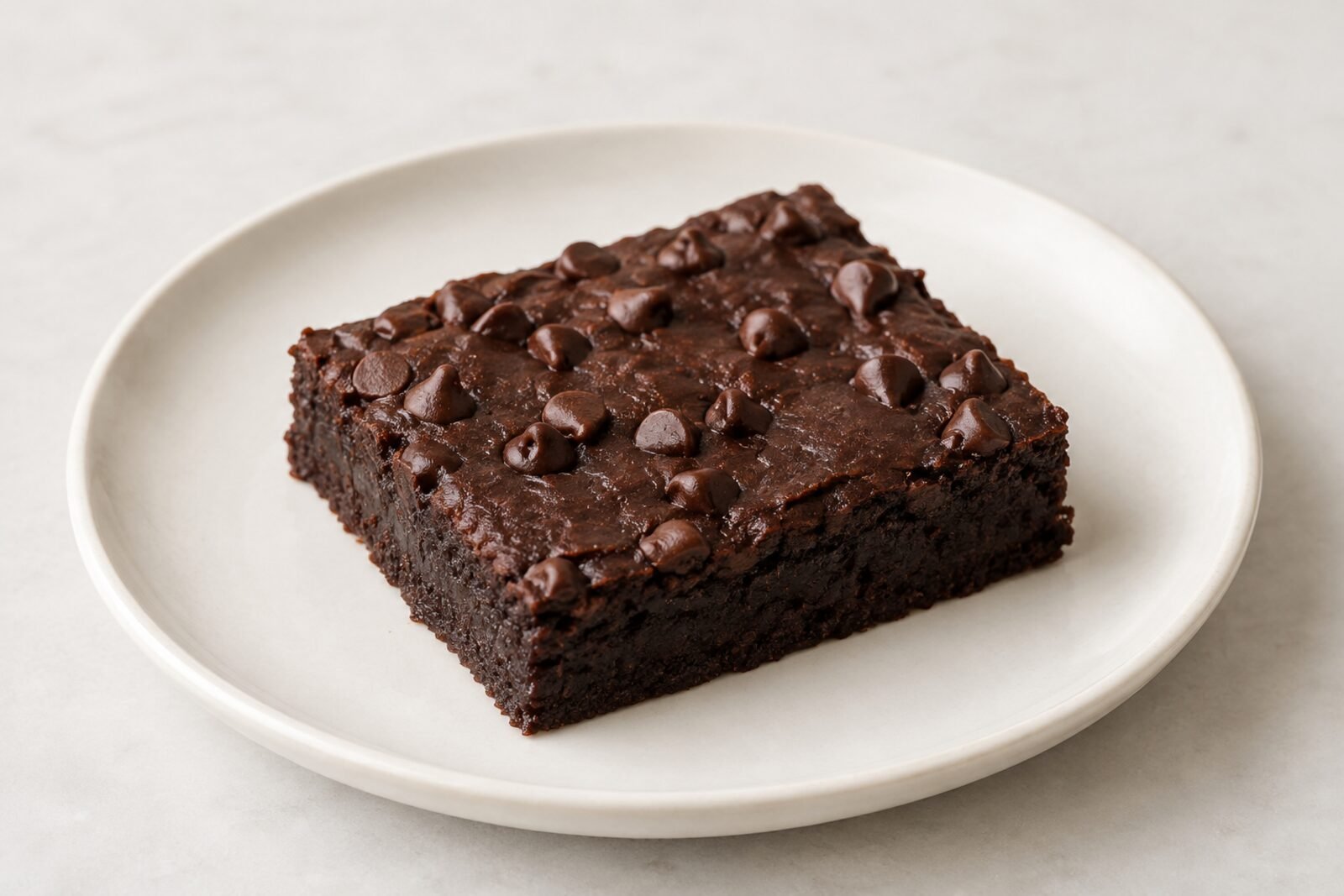
Two cans of black beans and five eggs make up most of the batter, and there is no flour at all. We went heavier on both than most bean brownies do so that each bar gets its protein from the beans and eggs, then used peanut butter in place of oil and a stated half cup of brown sugar for sweetness. They bake up dense and fudgy, closer to a flourless chocolate cake than a box mix.
Fifteen minutes with a food processor, 35 in the oven and an hour to cool before cutting. An 8-inch square pan lined with parchment is the only pan. Buy no-salt-added beans if you can (regular cans put about 130 mg more sodium in each bar), and rinse and drain them hard; canning liquid left on the beans is what makes a bean brownie taste like beans.
Why this one works
Beans and eggs replace the flour and most of the butter, and they carry 8 g of each bar's 11 g protein.
Peanut butter is the only added fat, in place of oil: 3 g of the 9 g fat per bar.
Brown sugar and a quarter cup of chips are the only sweeteners, both measured: together about 75 of the 240 kcal per bar.
The bars freeze individually for 3 months, so one pan at $0.70 a serving lasts weeks.
Ingredient notes
Black beans (two 15 oz cans / 480 g drained). No-salt-added leaves the salt in your hands. Shake them dry in the sieve; water left on them makes the middle gummy. Eggs (5 large / 250 g). They do the setting that flour usually does. Room-temperature eggs blend smoother; five minutes in warm water takes the chill off. Peanut butter (3 tbsp / 48 g). Creamy, stirred well. It reads as a faint roasted note under the cocoa. Almond butter is quieter. Light brown sugar (½ cup packed / 110 g). The main sweetener. Maple syrup makes a wetter, cakier bar; we stayed with sugar. Cocoa powder (½ cup / 40 g). Dutch-process gives darker, rounder brownies; natural cocoa is sharper. Both rise with the baking powder here.
Scales every quantity and the servings count. The panel stays per serving.
215 oz cans no-salt-added black beans (480 g drained), rinsed
5large eggs (250 g), at room temperature
½ cup(40 g) unsweetened cocoa powder
½ cuppacked (110 g) light brown sugar
3 tbsp(48 g) creamy peanut butter
2 tsp(8 g) vanilla extract
1 tsp(4 g) baking powder
¼ tsp(1.5 g) fine salt
¼ cup(42 g) semisweet chocolate chips
Method
Heat the oven to 350 °F (175 °C) with a rack in the middle. Line an 8-inch square pan with parchment, leaving an overhang on two sides.
Rinse the beans well and shake them dry in a sieve.
Put the beans and eggs in a food processor and blend 1 minute, until completely smooth with no bean skins visible.
Add the cocoa, brown sugar, peanut butter, vanilla, baking powder and salt. Blend 30 seconds, scraping down once, until glossy.
Stir in half the chocolate chips by hand. Scrape into the pan, smooth the top and scatter the rest of the chips over it.
Bake 30 to 35 minutes, until the center springs back and a toothpick comes out with moist crumbs but no wet batter.
Cool in the pan at least 1 hour. Lift out by the parchment and cut into 8 bars, two rows of four. Warm, they are gummy; cooled, they slice neatly.
Cook’s note
Blending the beans with the eggs alone, before the dry ingredients go in, is what breaks the skins down fully; add everything at once and you get speckles and a beany edge.
Storage
Airtight, 1 day at room temperature or 5 days in the fridge. Wrapped individually, they freeze 3 months; thaw 30 minutes on the counter. They are fudgier cold.
Nutrition
Nutrition Facts
8 servings per recipeServing size 1 of 8 servings
Calories per serving240
% Daily Value*
Total Fat 9g
12%
Saturated Fat 3g
15%
Sodium 200mg
9%
Total Carbohydrate 33g
12%
Dietary Fiber 6g
21%
Total Sugars 17g
Protein 11g
22%
* The % Daily Value tells you how much a nutrient in a serving of food contributes to a daily diet. 2,000 calories a day is used for general nutrition advice.
How this panel was built
Every ingredient in this recipe is mapped to a USDA FoodData Central entry and the panel is computed from those entries for one serving as written. Optional ingredients and anything "to taste" are excluded. Values are rounded: protein to the gram, calories to the nearest 5 and sodium to the nearest 10 mg. The panel is calculated, not lab-tested; a different brand of stock or cheese will move sodium and fat. Cost per serving is an estimate at national-average store-brand prices; your store will differ.