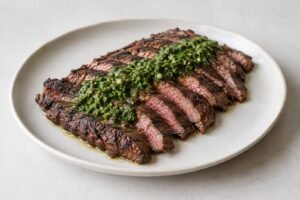
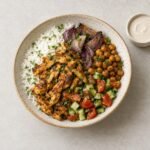
A whole flank steak salted 45 minutes ahead, grilled hard over the hottest part of the fire and sliced thin across the grain, with a chimichurri sharp enough to be the only sauce on the table. Flank is lean and full of beef flavor, so it needs nothing but salt and high heat. What it cannot take is cooking past medium, which is why we pull it at 130 °F (54 °C).
The steak sits for 45 minutes with its salt, which is also how long the chimichurri needs to settle. Look for a flank of even thickness, about 1 inch at the thick end. We cut the oil in the chimichurri to 2 tablespoons and make up the volume with water and red wine vinegar; it still clings to the meat.
Why this one works
44 g protein per serving, 43 g of it from 7 oz (200 g) of raw flank steak per person.
The chimichurri carries 2 tbsp olive oil for four, which adds 60 kcal a serving; a half-cup version adds 185 kcal more.
850 mg sodium per serving, 580 mg of it from the 1 tsp salt on the steak, which seasons it all the way through without a marinade.
Parsley, oregano, garlic, shallot and vinegar give the sauce its body and together come to under 20 kcal a serving.
Ingredient notes
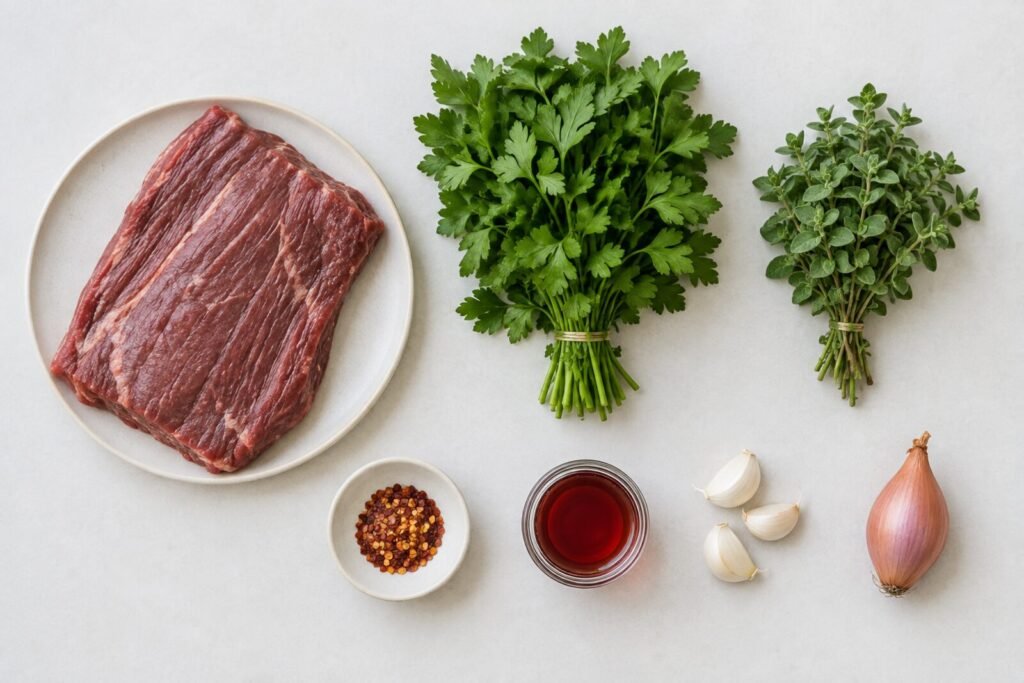
Flank steak (1¾ lb / 800 g). One large steak or two small ones. Trim off any silverskin. Skirt steak cooks faster and carries more fat; sirloin flap is the closest substitute. Flat-leaf parsley (1 large bunch / 60 g leaves). Leaves and the thin upper stems only. The thick lower stems make the sauce stringy. Red wine vinegar (3 tbsp / 45 ml). It carries the sauce now that the oil is cut back. Sherry vinegar is rounder and costs more. Fresh oregano (1 tbsp / 3 g). It is what makes this taste Argentine rather than like an Italian salsa verde. ½ tsp dried oregano works in winter. Neutral oil for the grates (1 tsp / 4.5 g). Wiped on and mostly burned off, so we count a quarter of the grate oil as eaten.
Scales every quantity and the servings count. The panel stays per serving.
1¾ lb(800 g) flank steak, trimmed
1 tsp(6 g) fine salt
½ tsp(1 g) black pepper
1large bunch flat-leaf parsley (60 g leaves), finely chopped
1 tbsp(3 g) fresh oregano leaves, finely chopped
3garlic cloves (9 g), minced
1small shallot (30 g), minced
½ tsp(1 g) red pepper flakes
3 tbsp(45 ml) red wine vinegar
2 tbsp(30 ml) water
2 tbsp(28 g) extra-virgin olive oil
¼ tsp(1.5 g) fine salt, for the chimichurri
1 tsp(4.5 g) neutral oil, for the grates
Method
Pat the steak dry and season both sides with the 1 tsp salt and the pepper. Leave it on a rack set over a plate at room temperature for 45 minutes.
Make the chimichurri: stir the parsley, oregano, garlic, shallot, pepper flakes, vinegar, water, olive oil and ¼ tsp salt together. Let it stand while the steak sits.
Heat the grill on high, lid closed, for 15 minutes, to 500 °F (260 °C) or hotter. Scrub the grates and wipe them with the neutral oil.
Pat the steak dry again. Grill over the hottest spot, lid open, 4 to 5 minutes per side, until charred and the thick end reads 130 °F for medium-rare or 140 °F (60 °C) for medium.
Move the steak to a board and rest it 10 minutes. The temperature climbs about 5 degrees as it sits.
Slice thinly against the grain, angling the knife, into ¼-inch strips. Spoon half the chimichurri over the slices and serve the rest at the table.
Cook’s note
Slicing across the grain is what makes flank tender, so find the long lines of muscle and cut at a right angle to them; without a grill, use a cast-iron grill pan or skillet over high heat, 4 to 5 minutes per side, with the fan on.
Storage
Refrigerate the sliced steak 3 days and the chimichurri 5 days, separately; the parsley darkens but tastes the same. Eat the steak cold or warm it for a minute in a hot skillet so it stays at medium. The cooked steak freezes 2 months.
Nutrition
Nutrition Facts
4 servings per recipeServing size 1 of 4 servings
Calories per serving380
% Daily Value*
Total Fat 20g
26%
Saturated Fat 6g
30%
Sodium 850mg
37%
Total Carbohydrate 4g
1%
Dietary Fiber 1g
4%
Total Sugars 1g
Protein 44g
88%
* The % Daily Value tells you how much a nutrient in a serving of food contributes to a daily diet. 2,000 calories a day is used for general nutrition advice.
How this panel was built
Every ingredient in this recipe is mapped to a USDA FoodData Central entry and the panel is computed from those entries for one serving as written. Optional ingredients and anything "to taste" are excluded. Values are rounded: protein to the gram, calories to the nearest 5 and sodium to the nearest 10 mg. The panel is calculated, not lab-tested; a different brand of stock or cheese will move sodium and fat. Cost per serving is an estimate at national-average store-brand prices; your store will differ.