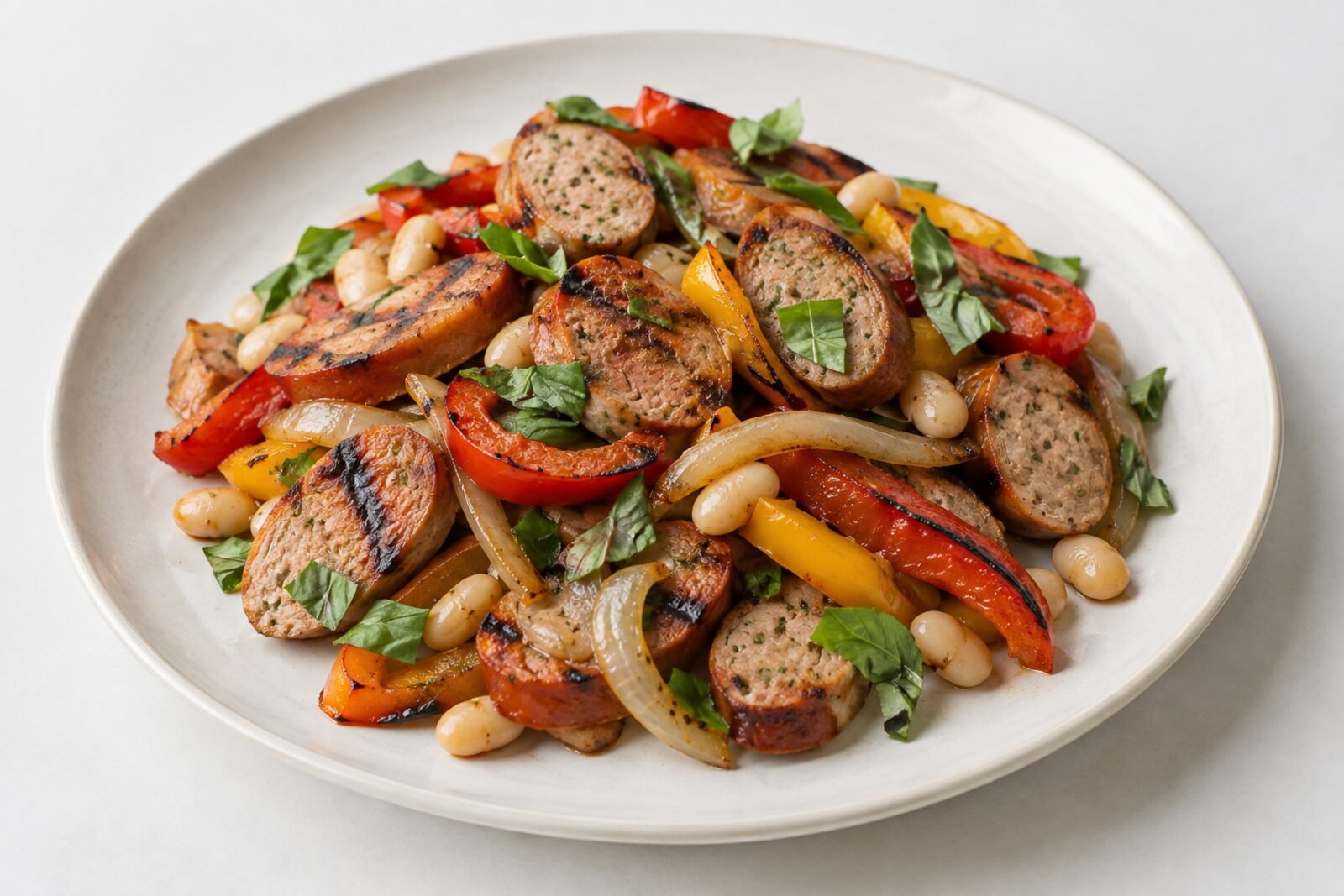
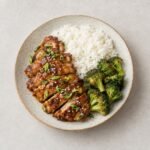
The street-fair sandwich, rebuilt as a plate. Fully cooked chicken sausages only need heating through, so most of the grill time goes to the peppers and onions, cooked in big flat pieces until soft and blackened at the edges, then sliced and tossed with a can of white beans, red wine vinegar and oregano. The beans soak up the vinegar and stand in for the roll.
Thirty-five minutes on a two-zone grill. Chicken sausages vary a lot between brands in fat and salt, so read the labels and pick one that lists chicken first. There is no added salt in this recipe for that reason; the sausage brings enough. A roll is optional; the slice of toasted sourdough under What to serve with it shows what bread adds.
Why this one works
35 g protein per serving: 28 g from two chicken sausage links and 4 g from the white beans, which add 4 g fiber too.
No added salt anywhere: the sausage already carries 1,050 mg of the 1,060 mg sodium per serving.
The beans take the place of the roll: 65 kcal per serving from the can, and no bread unless you add it.
Two teaspoons of olive oil for the vegetables adds 20 kcal per serving, and the sausages need none.
Ingredient notes
Fully cooked chicken sausage (two 12 oz packages, 8 links / 680 g). Italian-style, sweet or hot. Raw chicken sausage works too: grill it on the low side for 12 to 15 minutes, turning, to 165 °F (74 °C). Bell peppers (3 / 450 g). A mix of colors, quartered and flattened so they lie on the grates. No-salt-added cannellini beans (one 15 oz can / 240 g drained). Tossed with the hot vegetables, which warm them through. Great northern beans work the same. Red wine vinegar (1 tbsp / 15 ml). The acid that ties sausage, peppers and beans together. Neutral oil for the grates (1 tsp / 4.5 g). Most of it stays on the grate; we count a quarter of it as eaten.
115 oz can no-salt-added cannellini beans (240 g drained), rinsed
1 tbsp(15 ml) red wine vinegar
1garlic clove (3 g), grated
1 tsp(1 g) dried oregano
½ tsp(1 g) red pepper flakes
¼ cup(6 g) basil or parsley leaves, torn
Spicy brown mustard, optional
Method
Push a toothpick through each onion round from the side so the rings hold together. Brush the onions and pepper quarters with the olive oil.
Set up two zones: one side on medium-high, about 425 °F (220 °C), and one side on low. Scrub the grates and wipe them with the neutral oil.
Grill the peppers skin side down and the onions over direct heat, lid closed, 5 to 6 minutes per side, until soft and charred in patches.
Meanwhile, grill the sausages on the low side, turning every 2 minutes, for 8 to 10 minutes, until browned and the centre reads 165 °F.
Slice the peppers into strips and separate the onion rings into a large bowl, discarding the toothpicks.
Add the beans, vinegar, garlic, oregano and pepper flakes to the hot vegetables and toss until the beans are warm.
Slice the sausages on the diagonal or leave them whole. Pile them over the peppers and beans, scatter the basil and serve with mustard.
Cook’s note
Pre-cooked sausages split and dry out over high heat, so they warm through on the low side while the vegetables char on the hot side; without a grill, broil everything on a foil-lined sheet pan on the top rack for 12 to 15 minutes, turning once.
Storage
Refrigerate 4 days. Reheat in a skillet, or eat the pepper and bean mixture at room temperature. Freezes 2 months, though the peppers soften.
Nutrition
Nutrition Facts
4 servings per recipeServing size 1 of 4 servings
Calories per serving415
% Daily Value*
Total Fat 19g
24%
Saturated Fat 5g
25%
Sodium 1,060mg
46%
Total Carbohydrate 30g
11%
Dietary Fiber 8g
29%
Total Sugars 10g
Protein 35g
70%
* The % Daily Value tells you how much a nutrient in a serving of food contributes to a daily diet. 2,000 calories a day is used for general nutrition advice.
How this panel was built
Every ingredient in this recipe is mapped to a USDA FoodData Central entry and the panel is computed from those entries for one serving as written. Optional ingredients and anything "to taste" are excluded. Values are rounded: protein to the gram, calories to the nearest 5 and sodium to the nearest 10 mg. The panel is calculated, not lab-tested; a different brand of stock or cheese will move sodium and fat. Cost per serving is an estimate at national-average store-brand prices; your store will differ.