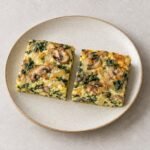
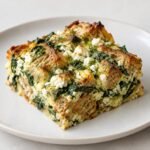
A sheet of egg whites baked in one pan, cut into six squares and stacked on whole-wheat English muffins with sharp cheddar and roast turkey breast. Baking the whites instead of frying six rounds is what makes this a 40-minute batch job. Two whole eggs in the pan keep the whites tender and give them a little color; whites alone bake up squeaky and pale.
You need a 9 by 13-inch metal baking pan, parchment and an oven. One sandwich is a serving. We use lower-sodium oven-roasted turkey breast from the deli case instead of the ham in our ham, egg and cheese sandwich, and toast the muffins before freezing so they reheat without going soggy. Cool everything completely before wrapping.
Why this one works
The baked egg square carries 15 g of the 33 g protein per sandwich; the turkey adds 7 g, the muffin 6 g and one slice of cheddar 5 g.
The whites bake at 325 °F (165 °C), so they set evenly with no browned, rubbery edges.
The added salt is ¼ tsp, but the muffin, deli turkey, whites and cheddar all bring some: 950 mg sodium per sandwich, 250 mg of it from the turkey.
Six sandwiches at $2.49 a serving freeze for 2 months and reheat in about 2 minutes.
Ingredient notes
Liquid egg whites (3 cups / 720 g). From a carton; about two 16 oz cartons. Carton whites pour into an even layer and bake flatter than separated whites. Lower-sodium oven-roasted turkey breast (9 oz / 255 g). Thinly sliced from the deli case or prepacked; look for lower sodium on the label. Fold the slices to fit the muffin. Turkey breast you roast and slice yourself takes off 200 mg sodium and $0.18 per sandwich. Whole-wheat English muffins (6 muffins / 396 g). Split with a fork rather than a knife so the nooks crisp in the toaster. Sharp cheddar slices (6 slices / 126 g). Deli-sliced, about ¾ oz each. Sharp cheddar holds its flavor through freezing better than mild.
Heat the oven to 325 °F (165 °C) with a rack in the middle. Line a 9 by 13-inch metal pan with parchment, letting it hang over the long sides, and brush it with the oil.
Whisk the egg whites, eggs, salt and pepper until no streaks of yolk remain. Stir in the spinach and scallions.
Pour into the pan and bake 18 to 22 minutes, until the center is set and springs back when pressed, with no liquid when you tilt the pan.
Meanwhile, toast the muffins until light golden, about 3 minutes. Spread them on a rack to cool.
Lift the egg out by the parchment and cut into 6 squares, 3 by 2. Let cool 10 minutes on the parchment.
Build each sandwich: muffin bottom, a slice of cheddar, an egg square with the corners folded under, a sixth of the turkey, muffin top.
Cool the sandwiches 5 minutes more, until room temperature, then wrap each in parchment and stack in a zip-top freezer bag.
Freeze at least 2 hours, until solid.
To reheat from frozen, unwrap, wrap in a paper towel and microwave at half power 90 seconds. Flip and microwave at full power 30 to 45 seconds, until hot in the center.
Cook’s note
The 325 °F oven is the point: at 375 °F the whites puff, brown at the edges and tighten into a rubbery sheet, while low heat sets them tender from edge to center.
Storage
Freeze up to 2 months or refrigerate up to 4 days. From the fridge, microwave 45 to 60 seconds. For a crisp muffin, thaw overnight and heat 8 minutes at 350 °F (175 °C) in the oven or air fryer.
Nutrition
Nutrition Facts
6 servings per recipeServing size 1 of 6 servings
Calories per serving360
% Daily Value*
Total Fat 12g
15%
Saturated Fat 5g
25%
Sodium 950mg
41%
Total Carbohydrate 30g
11%
Dietary Fiber 4.5g
16%
Total Sugars 7g
Protein 33g
66%
* The % Daily Value tells you how much a nutrient in a serving of food contributes to a daily diet. 2,000 calories a day is used for general nutrition advice.
How this panel was built
Every ingredient in this recipe is mapped to a USDA FoodData Central entry and the panel is computed from those entries for one serving as written. Optional ingredients and anything "to taste" are excluded. Values are rounded: protein to the gram, calories to the nearest 5 and sodium to the nearest 10 mg. The panel is calculated, not lab-tested; a different brand of stock or cheese will move sodium and fat. Cost per serving is an estimate at national-average store-brand prices; your store will differ.