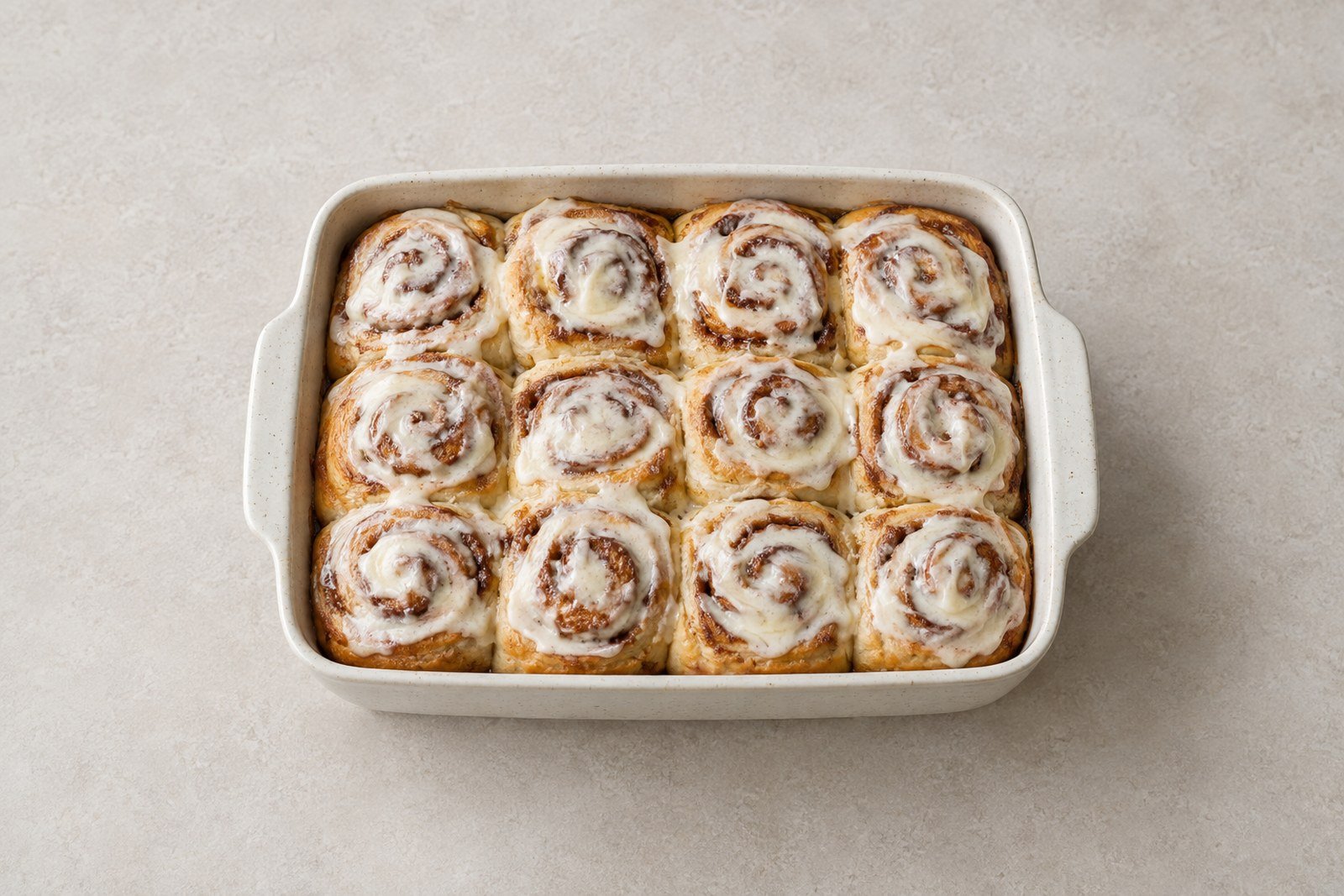
Cinnamon rolls are the Christmas morning breakfast: a soft yeast dough rolled around butter, brown sugar and cinnamon, baked until the centers are gooey and spread with cream cheese frosting while warm. This is a cheat meal, made the classic way, and it doesn’t pretend otherwise.
About 3 hours, nearly all of it rising and baking. For Christmas morning, shape them the night before, refrigerate them in the pan up to 12 hours, then let them sit out about 1 hour, until puffy, before baking. The frosting goes on while the rolls are warm so it melts into the spirals.
Why this one works
Butter in the dough, filling and frosting brings 11 g of the 14 g fat per roll.
Brown sugar and cinnamon in the filling: 13 g of the 31 g sugars per roll.
A Neufchâtel frosting with powdered sugar adds another 12 g of the 31 g sugars per roll.
Twelve rolls from one pan at $0.51 each, with 405 calories and 250 mg sodium.
Ingredient notes
All-purpose flour (4 cups / 480 g). Spoon it into the cup and level it; packed flour makes a dense roll. Keep a little more for the counter. Instant yeast (2¼ tsp / 7 g). One packet. It goes straight in with the flour. If you only have active dry, stir it into the warm milk first and give it 5 minutes. Milk (1 cup / 240 ml). Warm it to about 110 °F (43 °C), like a warm bath; hotter can kill the yeast. Neufchâtel (4 oz / 113 g). The ⅓-less-fat cream cheese. It makes a tangy frosting that sets softly.
Scales every quantity and the servings count. The panel stays per serving.
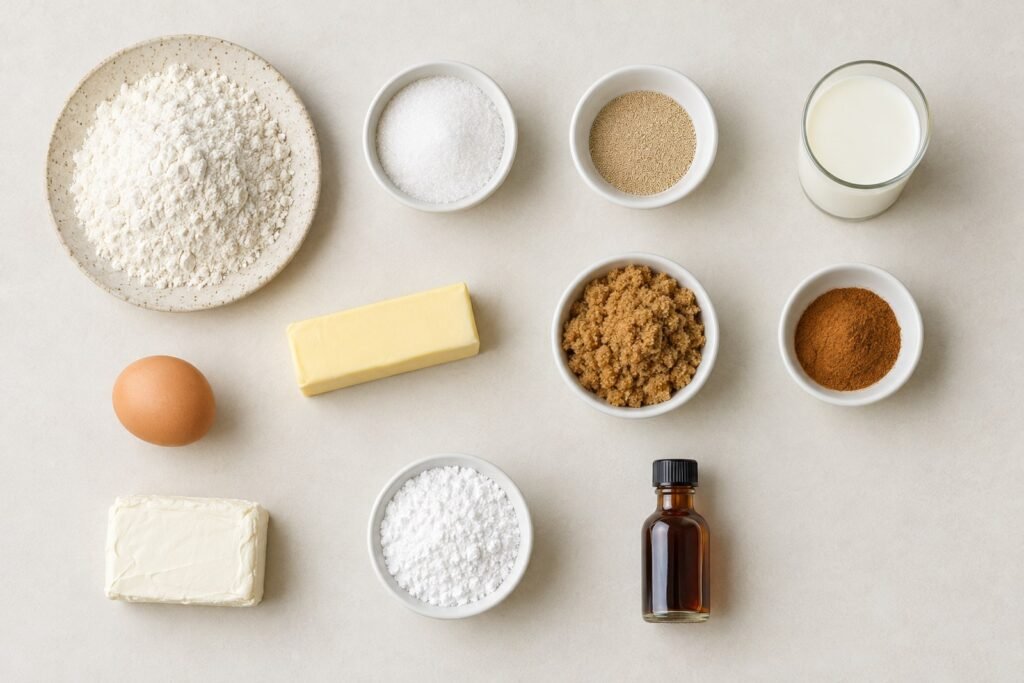
4 cups(480 g) all-purpose flour
¼ cup(50 g) granulated sugar
2¼ tsp(7 g) instant yeast
1 tsp(6 g) fine salt
1 cup(240 ml) 2% milk, warmed
1large egg
¼ cup(57 g) unsalted butter, softened, for the dough
⅓ cup(76 g) unsalted butter, softened, for the filling
¾ cup(165 g) brown sugar
2 tbsp(16 g) ground cinnamon
4 oz(113 g) Neufchâtel cheese, softened
2 tbsp(28 g) unsalted butter, softened, for the frosting
1¼ cups(150 g) powdered sugar
1 tsp(4 g) vanilla extract
Method
Whisk the flour, granulated sugar, yeast and salt in a large bowl. Add the warm milk, egg and dough butter and stir until a shaggy dough forms. Knead on a lightly floured counter until smooth and elastic, about 8 minutes. Put it in a lightly greased bowl, cover and let rise in a warm place until doubled, about 1½ hours.
Stir the filling butter, brown sugar and cinnamon into a paste. Roll the dough out to a rectangle about 12 by 18 inches, spread the paste over it, leaving a ½-inch border, and roll it up tightly from a long side.
Cut the log into 12 even rolls and set them cut side up in a greased 9-by-13-inch baking dish. Cover and let rise until puffy and touching, about 30 minutes.
Heat the oven to 350 °F (175 °C). Bake 22 to 25 minutes, until golden and a thermometer in a center roll reads 190 °F (88 °C). Cool in the pan 10 minutes.
Beat the Neufchâtel and frosting butter until smooth, then beat in the powdered sugar and vanilla. Spread over the warm rolls and serve.
Cook’s note
Cut the log with a length of unflavored dental floss: slide it under, cross the ends over the top and pull. It cuts clean rounds without squashing the spiral the way a knife can.
Storage
Refrigerate frosted rolls within 2 hours, covered, up to 4 days. Unfrosted rolls keep covered at room temperature up to 2 days. Rewarm in the microwave 20 seconds. Unfrosted rolls freeze up to 2 months; thaw, warm and frost.
Nutrition
Nutrition Facts
12 servings per recipeServing size 1 of 12 servings
Calories per serving405
% Daily Value*
Total Fat 14g
18%
Saturated Fat 8g
40%
Sodium 250mg
11%
Total Carbohydrate 63g
23%
Dietary Fiber 2g
7%
Total Sugars 31g
Protein 7g
14%
* The % Daily Value tells you how much a nutrient in a serving of food contributes to a daily diet. 2,000 calories a day is used for general nutrition advice.
How this panel was built
Every ingredient in this recipe is mapped to a USDA FoodData Central entry and the panel is computed from those entries for one serving as written. Optional ingredients and anything "to taste" are excluded. Values are rounded: protein to the gram, calories to the nearest 5 and sodium to the nearest 10 mg. The panel is calculated, not lab-tested; a different brand of stock or cheese will move sodium and fat. Cost per serving is an estimate at national-average store-brand prices; your store will differ.