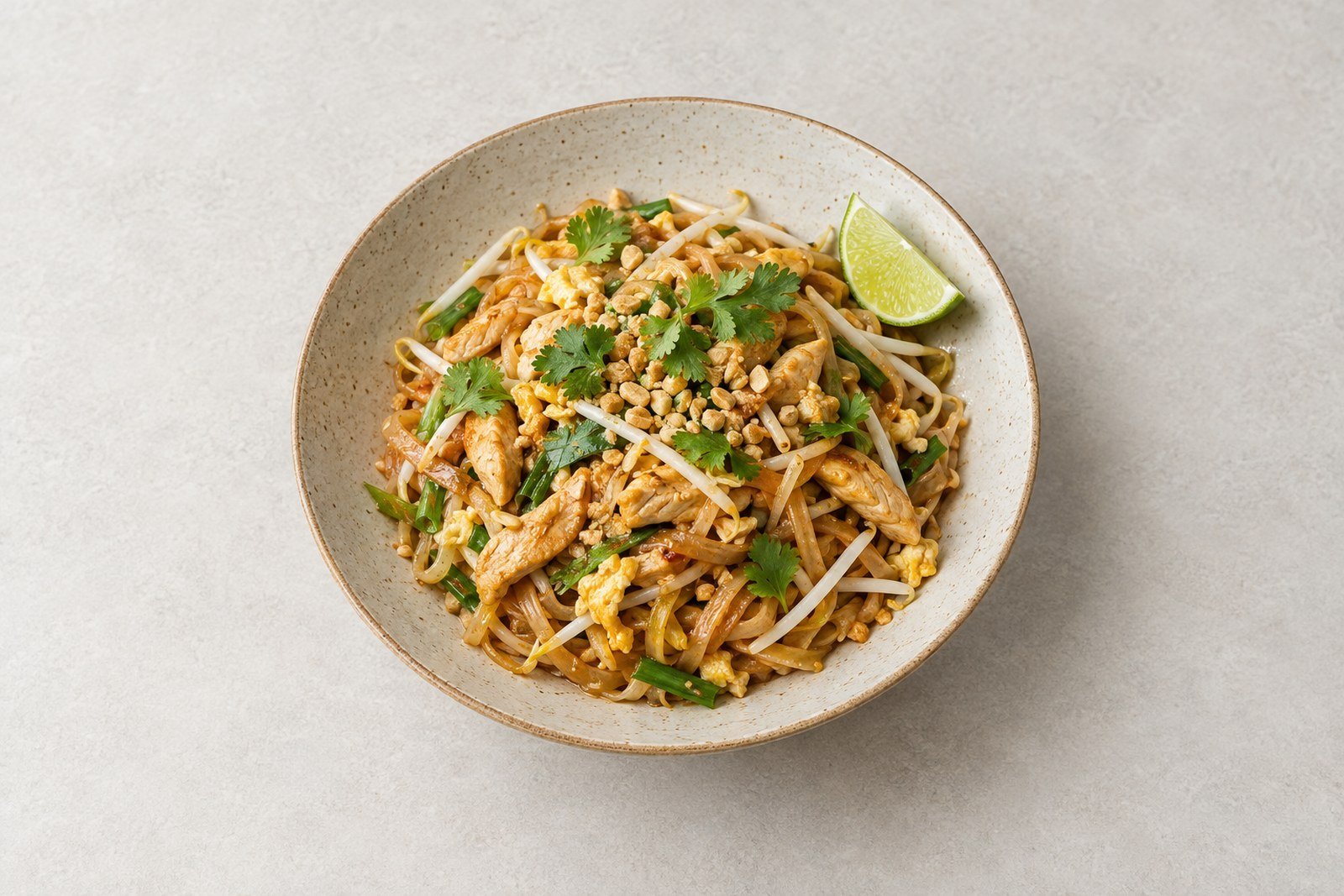
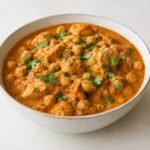
Pad thai is the stir-fried rice noodle dish sold from street carts across Bangkok: flat noodles tossed in a hot pan with egg, bean sprouts and scallions, seasoned with tamarind, fish sauce and palm sugar, and finished with peanuts and lime. Ours makes chicken breast the main event and keeps the noodles to 6 ounces for four, so the bowl is mostly chicken, egg and sprouts rather than noodles.
The noodles soak while you slice the chicken and make the sauce, then everything cooks in one skillet in about 15 minutes. Tamarind pulp gives pad thai its sour, fruity taste; ketchup and vinegar shortcuts do not. Find the pulp in blocks at Asian and Latin markets, or in the international aisle.
Why this one works
A pound and a quarter of chicken breast for four bowls: 32 g of the 45 g protein per bowl, and the three eggs add 5 g more.
Six ounces of dry noodles for four bowls: 155 of the 585 calories per bowl, with bean sprouts and egg filling out the pan.
Two tablespoons of fish sauce and no added salt: 705 mg of the 920 mg sodium per bowl, and the one-tablespoon swap takes off 350 mg.
Two tablespoons of oil for the whole pan: 7 g of the 19 g fat per bowl, at $2.92 a bowl.
Ingredient notes
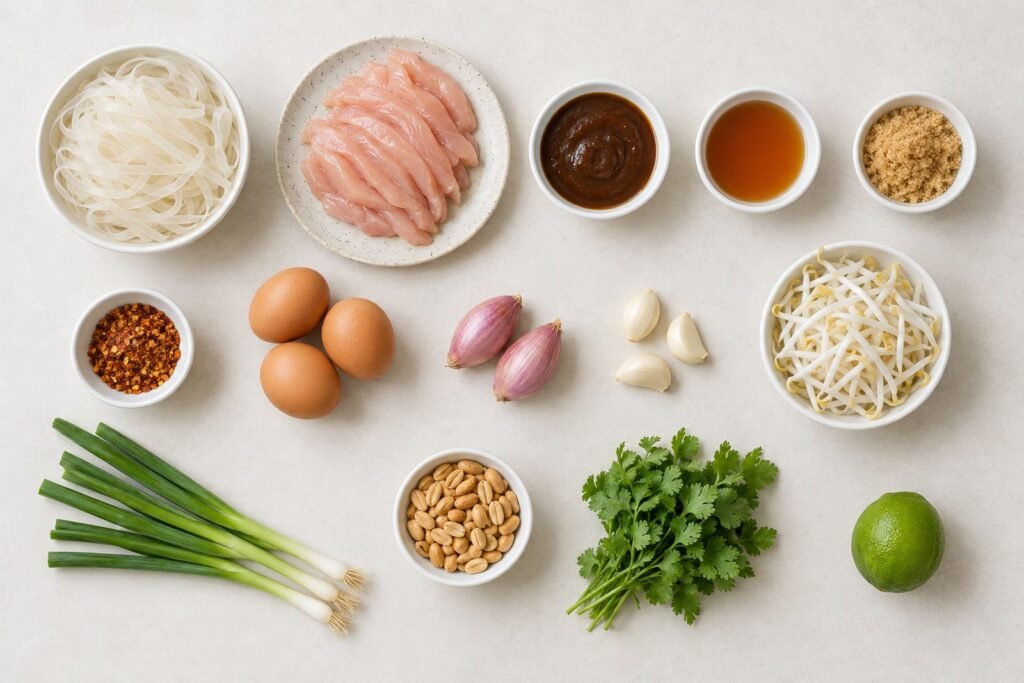
Flat rice noodles (6 oz / 170 g dry). Sold as pad thai or rice stick noodles, about ¼ inch wide. Soak them until bendable but still firm at the center; they finish softening in the pan. Seedless tamarind pulp (1½ oz / 40 g). A sticky brown block. Soaked in hot water and pressed through a sieve, it gives a sour purée. Jarred tamarind concentrate is stronger: use 1½ tablespoons in its place, stir it into the ½ cup water, and skip the soaking and sieving. Fish sauce (2 tbsp / 30 ml). Most of the dish's salt. Check the label if you need it gluten-free; most are, but some add wheat. Boneless skinless chicken breast (1¼ lb / 570 g). Slicing it thin and across the grain lets it cook through in about 3 minutes. Partly frozen chicken slices more easily.
Put the noodles in a large bowl and cover with very hot tap water. Soak 15 minutes, until bendable but still firm at the center, then drain.
Meanwhile, soak the tamarind in the ½ cup hot water for 10 minutes. Mash it with a fork and press it through a fine sieve into a bowl, scraping the underside; discard the seeds and fibers. Stir in the fish sauce, brown sugar and pepper flakes.
Heat 1 tbsp of the oil in a 12-inch skillet over high. Add half the chicken in one layer and cook 3 to 4 minutes, stirring, until cooked through. Move to a plate and repeat with the rest.
Add the remaining 1 tbsp oil, the shallots and garlic and stir 30 seconds. Push them to one side, crack in the eggs and scramble 1 minute, until just set.
Add the noodles and the tamarind sauce and toss 2 to 3 minutes, until the noodles soak up the sauce and turn tender. Add 2 tablespoons of water if they stick.
Return the chicken with the bean sprouts and scallions and toss 1 minute. Serve topped with the peanuts and cilantro, with lime wedges.
Cook’s note
Pull the noodles from the soak while they still have a firm white core. They keep softening in the sauce, and noodles soaked until soft turn to a sticky mass in the pan.
Storage
Refrigerate up to 3 days. Reheat in a skillet with a splash of water. The noodles do not freeze well.
Nutrition
Nutrition Facts
4 servings per recipeServing size 1 of 4 servings
Calories per serving585
% Daily Value*
Total Fat 19g
24%
Saturated Fat 3.5g
18%
Sodium 920mg
40%
Total Carbohydrate 58g
21%
Dietary Fiber 4g
14%
Total Sugars 16g
Protein 45g
90%
* The % Daily Value tells you how much a nutrient in a serving of food contributes to a daily diet. 2,000 calories a day is used for general nutrition advice.
How this panel was built
Every ingredient in this recipe is mapped to a USDA FoodData Central entry and the panel is computed from those entries for one serving as written. Optional ingredients and anything "to taste" are excluded. Values are rounded: protein to the gram, calories to the nearest 5 and sodium to the nearest 10 mg. The panel is calculated, not lab-tested; a different brand of stock or cheese will move sodium and fat. Cost per serving is an estimate at national-average store-brand prices; your store will differ.