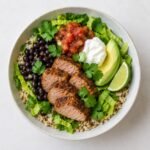
Everything that goes into a banh mi except the baguette: thin-sliced pork tenderloin marinated in lemongrass, garlic, fish sauce and brown sugar and seared until caramelized, with quick-pickled carrot and daikon, cucumber, jalapeño, cilantro and sriracha mayo, all over jasmine rice. Tenderloin is the leanest cut of pork in the case and it slices thin enough to take a marinade in 20 minutes; the pickles do the job the bread’s crackle would.
One 12-inch skillet and a small saucepan, about an hour including the 20-minute marinade, while the pickles sit. Look for lemongrass near the ginger; buy firm, pale stalks and use only the bottom 4 inches. Daikon is the long white radish; regular red radishes work if you cannot find it. The sriracha mayo is half Greek yogurt, so it stays thick in the fridge.
Why this one works
41 g protein per bowl, 36 g of it from pork tenderloin, the leanest pork cut in the case, which brings under 4 g fat per bowl.
The sriracha mayo is half Greek yogurt, so there are 2 tbsp of mayonnaise for four bowls; going all yogurt saves 35 kcal and 5 g fat per bowl.
One tablespoon of fish sauce seasons all the pork and the pickles carry no salt: 580 mg sodium per bowl, about 350 mg of it from the fish sauce.
The pickles keep two weeks and the pork reheats in 90 seconds, so the bowls hold four days, at $3.06 a bowl.
Ingredient notes
Pork tenderloin (1½ lb / 680 g). Trim the silver skin, then slice ⅛ inch thick across the grain. Twenty minutes in the freezer firms it up for slicing. Lemongrass (2 stalks / 30 g minced). Peel off the dry outer layers and mince the tender bottom part very fine; coarse pieces stay woody. Tubes of lemongrass paste work, about 2 tablespoons. Fish sauce (1 tbsp / 18 g). Gives the marinade its savory depth. Buy one with only anchovies and salt on the label. Daikon radish (4 oz / 115 g). A small piece from the long white radish, cut into matchsticks. Red radishes, thinly sliced, are a fine stand-in.
1½ lb(680 g) pork tenderloin, trimmed and sliced ⅛ inch thick
¾ cup(140 g) long-grain white rice, such as jasmine, rinsed
1¼ cups(300 ml) water, for the rice
1 tbsp(14 g) canola oil, divided
2 tbsp(28 g) mayonnaise
¼ cup(60 g) 2% Greek yogurt
2 tsp(10 g) sriracha
½English cucumber (150 g), cut into spears
1jalapeño (15 g), thinly sliced
½ cup(8 g) cilantro sprigs
Method
Stir the vinegar, warm water and sugar in a jar until dissolved. Add the carrots and daikon, pressing them under the brine. Leave at least 20 minutes.
Mix the lemongrass, garlic, shallot, fish sauce, brown sugar and pepper in a bowl. Add the pork and toss well. Marinate 20 minutes at room temperature, or up to 8 hours refrigerated.
Meanwhile, combine the rice and 1¼ cups water in a small saucepan. Boil, cover, reduce to low and cook 15 minutes. Rest off the heat, covered, 10 minutes.
Heat half the oil in a 12-inch skillet over high until it shimmers. Add half the pork in one layer.
Sear without moving 2 minutes, until caramelized underneath, then flip and cook 1 to 2 minutes more, until no pink remains and the pork reads 145 °F (63 °C). Transfer to a plate.
Repeat with the remaining oil and pork, scraping up the browned bits.
Stir the mayonnaise, yogurt and sriracha together.
Drain the pickles. Divide the rice, pork, pickles, cucumber and jalapeño among 4 containers, top with cilantro and pack the sriracha mayo in small cups.
Cook’s note
Searing in two batches keeps the pan hot enough for the brown sugar in the marinade to caramelize; crowded into one batch, the pork gives up liquid and simmers grey.
Storage
Refrigerate the bowls 4 days with the sauce separate. Reheat the pork and rice 90 seconds with the lid loose, then add the cold pickles and cucumber. Extra pickles keep 2 weeks in their brine. The pork and rice freeze 2 months; the pickles and fresh vegetables do not freeze.
Nutrition
Nutrition Facts
4 servings per recipeServing size 1 of 4 servings
Calories per serving470
% Daily Value*
Total Fat 13g
17%
Saturated Fat 2.5g
13%
Sodium 580mg
25%
Total Carbohydrate 45g
16%
Dietary Fiber 2.5g
9%
Total Sugars 11g
Protein 41g
82%
* The % Daily Value tells you how much a nutrient in a serving of food contributes to a daily diet. 2,000 calories a day is used for general nutrition advice.
How this panel was built
Every ingredient in this recipe is mapped to a USDA FoodData Central entry and the panel is computed from those entries for one serving as written. Optional ingredients and anything "to taste" are excluded. Values are rounded: protein to the gram, calories to the nearest 5 and sodium to the nearest 10 mg. The panel is calculated, not lab-tested; a different brand of stock or cheese will move sodium and fat. Cost per serving is an estimate at national-average store-brand prices; your store will differ.