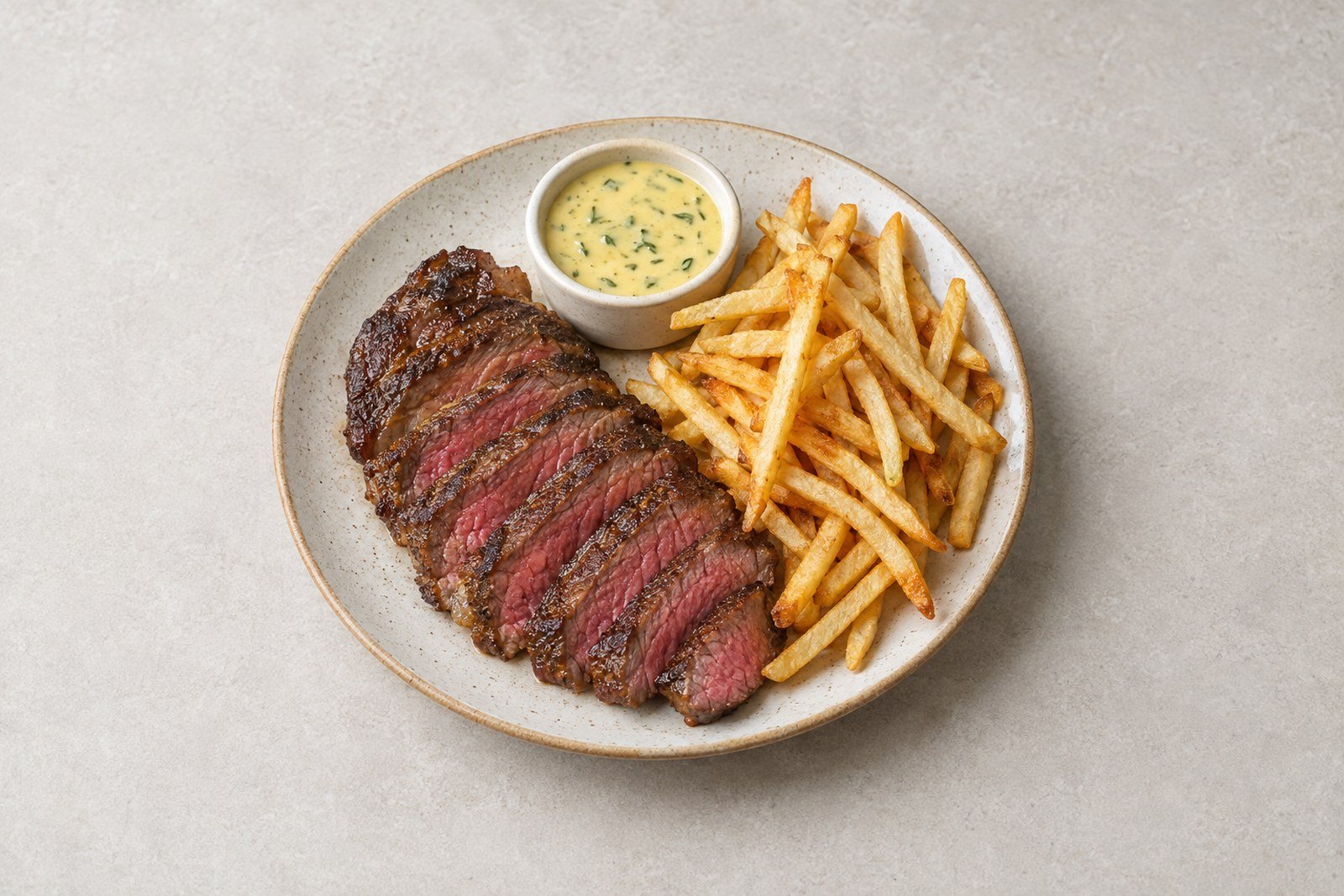
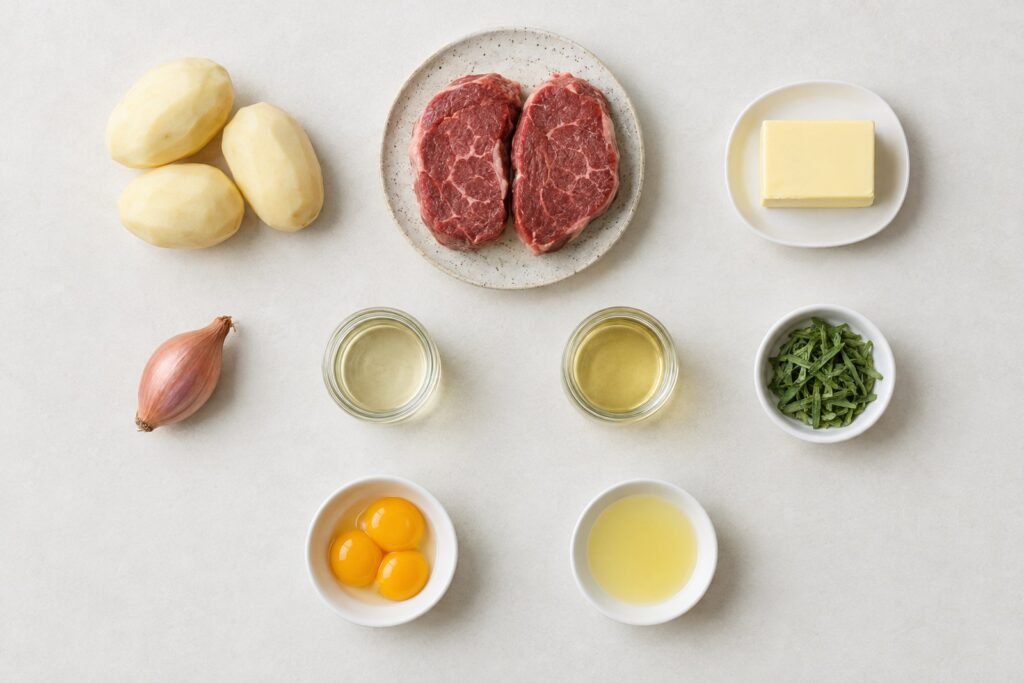
The Paris bistro plate: a thick sirloin seared hard in cast iron and basted with butter, a pile of thin, crisp fries, and a warm tarragon béarnaise to drag both through. We make the frites in the air fryer, which turns out a crisp, golden fry in two tablespoons of oil, and we spend the butter where it counts, in the sauce. Béarnaise is hollandaise with a shallot, vinegar and tarragon reduction; it sounds fussy and takes ten minutes.
Half a steak, a quarter of the frites and a quarter of the sauce make one serving. Buy two top sirloin steaks about 1¼ inches thick; thinner steaks overcook before they brown. Cut the fries first and get the first batch going, then sear the steaks and make the béarnaise during the second batch. You need a heatproof bowl that sits snugly over a small saucepan.
Why this one works
Half a pound of raw sirloin per person is a bistro portion, and it carries the protein on its own: 50 g of the 58 g per serving.
The frites use 2 tablespoons of oil for four people because they cook in the air fryer, not a fryer; that oil adds 60 kcal and 7 g fat per serving.
The butter is mostly in the béarnaise, a stick for four emulsified with three yolks; the sauce's butter adds 205 kcal and 23 g fat to each serving.
The salt is measured, on the steak and the frites, and the sauce gets only ⅛ tsp, since it is eaten with both: 1,240 mg sodium per serving, 1,090 mg of it from the added salt.
Ingredient notes
Top sirloin steaks (2 lb / 910 g). Lean, beefy and well priced. Strip steak or bavette (flank) is the bistro choice; flank cooks faster and must be sliced thinly across the grain. Russet potatoes (900 g peeled). About 2¼ lb before peeling. Russets are the floury, dry potato that crisps; waxy potatoes stay limp. Egg yolks (3 large / 54 g). Separated cold, then left to sit while you prep. Save the whites in the fridge for an omelet. The three yolks add about 45 kcal and 2 g protein per serving. Fresh tarragon (2 tbsp / 5 g). The flavor of béarnaise, sweet and faintly anise. Dried does not work here, though USDA's dried entry is the one we compute with, as it has no fresh tarragon; at 5 g it adds 4 kcal per serving. Half goes in the reduction and half is stirred in at the end. White wine vinegar (2 tbsp / 30 ml). Not distilled white vinegar, which is harsh. USDA has no white wine vinegar entry, so we compute it as red wine vinegar; at 2 tbsp for four it adds about 1 kcal per serving.
Scales every quantity and the servings count. The panel stays per serving.
2¼ lbrusset potatoes (900 g peeled)
2 tbsp(27 g) canola oil, for the frites
¾ tsp(4.5 g) fine salt, for the frites
2 lb(910 g) top sirloin steaks, 1¼ inches thick (2 steaks), trimmed of visible fat
1 tsp(6 g) fine salt, for the steaks
1 tsp(2 g) black pepper, coarsely cracked
1 tbsp(14 g) canola oil, for the pan
1 tbsp(14 g) unsalted butter, for basting
2thyme sprigs, optional
1small shallot (30 g), minced
2 tbsp(30 ml) white wine vinegar
2 tbsp(30 ml) dry white wine
2 tbsp(5 g) fresh tarragon, chopped, divided
3large egg yolks (54 g)
8 tbsp(113 g) unsalted butter, melted and still warm
1 tsp(5 ml) lemon juice
⅛ tsp(0.8 g) fine salt, for the sauce
Method
Cut the potatoes into ¼-inch (6 mm) sticks. Rinse in cold running water until it runs clear and dry thoroughly on a towel.
Toss with 2 tbsp oil. Preheat the air fryer to 380 °F (195 °C) for 3 minutes.
Cook half the potatoes, spread no more than two deep, 18 to 20 minutes in a 5- to 6-quart basket, shaking every 5 minutes, until golden and rigid. Tip onto a rack and cook the second batch.
During the second batch, pat the steaks dry and season with 1 tsp salt and the pepper. Heat a 12-inch cast-iron skillet over high for 4 minutes, until a drop of oil smokes.
Add 1 tbsp oil and the steaks. Sear 4 to 5 minutes without moving, until a dark crust forms. Flip and cook 3 minutes.
Add the butter and thyme, tilt the pan and spoon the foaming butter over the steaks for 1 minute, until 125 °F (52 °C) in the center for medium-rare (USDA advises 145 °F / 63 °C).
Rest the steaks on a board for 10 minutes while you make the sauce. Melt the 8 tbsp butter in the microwave in 20-second bursts and keep it warm.
Simmer the shallot, vinegar, wine and half the tarragon in a small saucepan over medium 3 to 4 minutes, until about 2 tbsp of liquid remain. Cool 1 minute.
Scrape the reduction into a heatproof bowl, whisk in the yolks and set over the saucepan with 1 inch of barely simmering water below, not touching the bowl.
Whisk constantly 2 to 3 minutes, until the yolks are pale, thick and leave trails. Lift the bowl off the heat if the sides start to scramble.
Off the heat, whisk in the warm butter a thin stream at a time until thick and glossy. Stir in the lemon juice, ⅛ tsp salt and the remaining tarragon.
Return all the frites to the basket and cook 3 minutes at 400 °F (205 °C) to re-crisp. Toss with ¾ tsp salt.
Slice the steaks across the grain and divide among plates with the frites, a quarter of the béarnaise on each.
Cook’s note
Béarnaise breaks when the yolks get too hot or the butter goes in too fast; whisking the yolks off and on the heat and adding the butter in a thin stream, warm but not sizzling, keeps it a stable emulsion.
Storage
Steak keeps 3 days in the fridge; slice it cold for sandwiches or warm it gently in a skillet. Béarnaise does not keep or reheat; make it fresh. Frites re-crisp 4 minutes at 380 °F in the air fryer, but they are at their peak straight away.
Nutrition
Nutrition Facts
4 servings per recipeServing size 1 of 4 servings
Calories per serving865
% Daily Value*
Total Fat 50g
64%
Saturated Fat 22g
110%
Sodium 1,240mg
54%
Total Carbohydrate 44g
16%
Dietary Fiber 3.5g
13%
Total Sugars 2g
Protein 58g
116%
* The % Daily Value tells you how much a nutrient in a serving of food contributes to a daily diet. 2,000 calories a day is used for general nutrition advice.
How this panel was built
Every ingredient in this recipe is mapped to a USDA FoodData Central entry and the panel is computed from those entries for one serving as written. Optional ingredients and anything "to taste" are excluded. Values are rounded: protein to the gram, calories to the nearest 5 and sodium to the nearest 10 mg. The panel is calculated, not lab-tested; a different brand of stock or cheese will move sodium and fat. Cost per serving is an estimate at national-average store-brand prices; your store will differ.