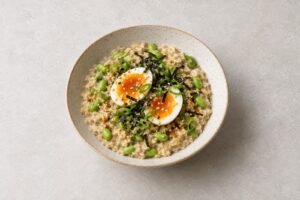
Oatmeal cooked like a savory porridge, closer to Japanese okayu than to breakfast cereal: rolled oats simmered with ginger and edamame, egg whites whisked in at the end until the pot turns thick and glossy, white miso stirred through off the heat, and a soft-boiled egg, scallions, nori and sesame on top. It is a different dish from our savory oats with egg and Parmesan; this one tastes of miso and the sea, not cheese.
One small saucepan and about 20 minutes: the eggs boil first, then the oats cook in the same water. Buy white (shiro) miso, which is milder and less salty than red, and rolled oats rather than instant, which turn to paste. The egg whites come from a carton so none go to waste. Half the pot and one egg is a serving.
Why this one works
Oats, edamame, egg whites and a whole egg each add protein, so no single ingredient carries the bowl: 28 g protein per serving, 13 g from the egg and whites, 8 g from the edamame and 5 g from the oats.
Whisking ½ cup (120 g) of egg whites into the hot oats makes them creamy without milk or butter, and adds 30 kcal per serving.
One level tablespoon of miso seasons both bowls and brings 320 of the 590 mg sodium per serving; the low-sodium soy sauce on top adds 100 mg.
The eggs and the oats share one pot of water, and the bowl comes to $1.74 a serving.
Ingredient notes
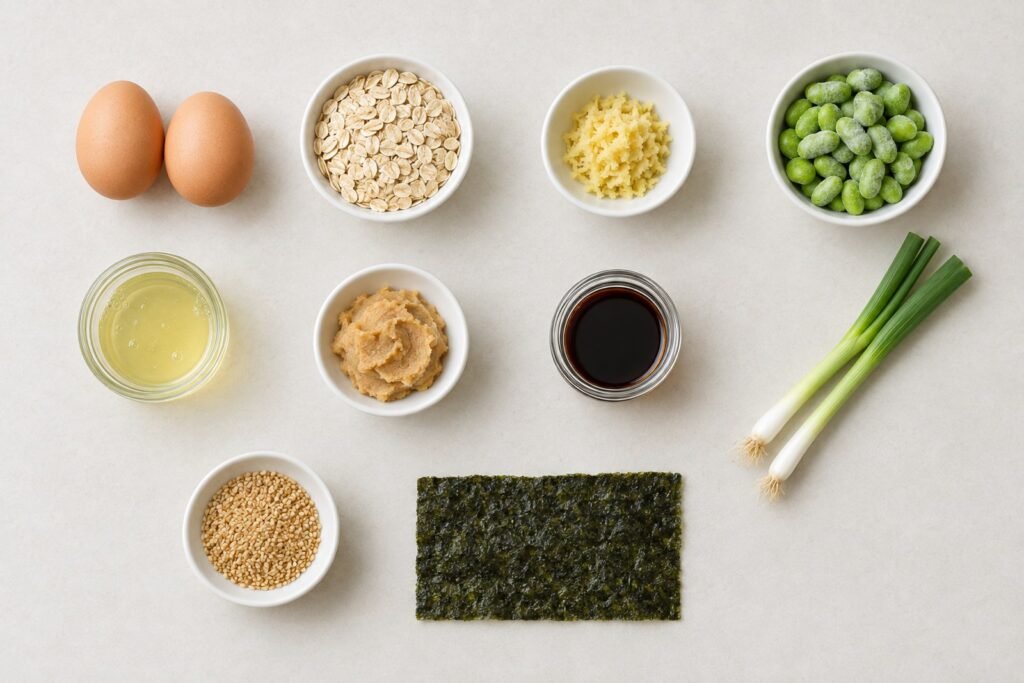
White miso (1 tbsp / 17 g). Shiro miso, sold refrigerated near the tofu. Add it off the heat; boiling dulls its flavor. It carries most of the salt in the bowl, about 320 mg sodium per serving, so we measure it level; the 2 tsp swap takes off 110 mg. Rolled oats (1 cup / 80 g). Old-fashioned rolled oats. Steel-cut oats work but take 25 minutes and twice the water. Frozen shelled edamame (1 cup / 150 g). They go in straight from the freezer and cook with the oats. Liquid egg whites (½ cup / 120 g). From a carton. Pour them in slowly while stirring, or they set in ribbons instead of disappearing into the oats.
Scales every quantity and the servings count. The panel stays per serving.
3 cups(720 ml) water
2large eggs (100 g), cold from the fridge
1 cup(80 g) rolled oats
1 tsp(3 g) grated ginger
1 cup(150 g) frozen shelled edamame
½ cup(120 g) liquid egg whites
1 tbsp(17 g) white miso
1 tsp(5 ml) low-sodium soy sauce
2scallions (30 g), thinly sliced
1 tsp(3 g) toasted sesame seeds
½ tsp(2 g) toasted sesame oil
1sheet nori (3 g), cut into thin strips
Shichimi togarashi or chili crisp, optional
Method
Bring the water to a boil in a 2-quart saucepan. Lower in the eggs and boil 6½ minutes.
Lift the eggs into a bowl of cold water. Measure the cooking water and top it up to 2 cups (480 ml) if needed, then return it to the pan.
Bring the water back to a boil. Stir in the oats, ginger and edamame, and simmer over medium-low, stirring often, 5 minutes, until the oats are tender.
Pour in the egg whites in a thin stream while stirring constantly. Cook 1 to 2 minutes, until the oatmeal is thick and glossy with no translucent streaks.
Take the pan off the heat. Mix the miso with 2 tbsp of the hot oatmeal in a cup until smooth, then stir it back into the pot.
Peel and halve the eggs. Divide the oatmeal between two bowls and top with the eggs, scallions, sesame seeds, sesame oil, nori and soy sauce.
Cook’s note
Loosen the miso in a little hot oatmeal before stirring it in; dropped straight into the pot it stays in salty lumps.
Storage
Best eaten right away. The oatmeal keeps 3 days in the fridge and sets firm; reheat with ¼ cup water, stirring, about 2 minutes in the microwave. Soft-boiled eggs keep 3 days in their shells. Does not freeze.
Nutrition
Nutrition Facts
2 servings per recipeServing size 1 of 2 servings
Calories per serving380
% Daily Value*
Total Fat 13g
17%
Saturated Fat 3g
15%
Sodium 590mg
26%
Total Carbohydrate 38g
14%
Dietary Fiber 9g
32%
Total Sugars 4g
Protein 28g
56%
* The % Daily Value tells you how much a nutrient in a serving of food contributes to a daily diet. 2,000 calories a day is used for general nutrition advice.
How this panel was built
Every ingredient in this recipe is mapped to a USDA FoodData Central entry and the panel is computed from those entries for one serving as written. Optional ingredients and anything "to taste" are excluded. Values are rounded: protein to the gram, calories to the nearest 5 and sodium to the nearest 10 mg. The panel is calculated, not lab-tested; a different brand of stock or cheese will move sodium and fat. Cost per serving is an estimate at national-average store-brand prices; your store will differ.