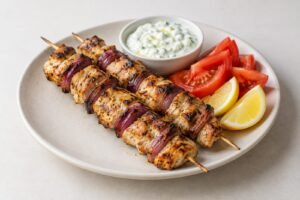
Souvlaki the way a taverna grill does it: small cubes of chicken, lemon, garlic and dried oregano, high heat and not much else. We replaced most of the usual olive-oil marinade with Greek yogurt, which clings to the meat, browns at the edges and keeps breast meat from drying out over direct flame. The same yogurt comes back thicker, with grated cucumber and dill, as the tzatziki.
Allow an hour for marinating, or up to 8, and soak the wooden skewers while you wait. Buy whole breasts rather than tenders; they cut into more even cubes, and even cubes finish together. Squeeze the grated cucumber hard in a clean towel, or the tzatziki turns watery by the time the chicken comes off the grill.
Why this one works
The marinade carries 1 tbsp olive oil for four, which adds about 30 kcal a serving; nonfat yogurt does the clinging and the browning.
The tzatziki is mostly strained 2% yogurt, so 6 g protein per serving comes from the sauce, with about 1 g fat.
47 g protein per serving, 38 g of it from the breast meat; small cubes come off at 165 °F before they dry out.
690 mg sodium per serving, 580 mg of it from the 1 tsp salt split between marinade and tzatziki; the swaps table has a −440 mg row.
Ingredient notes
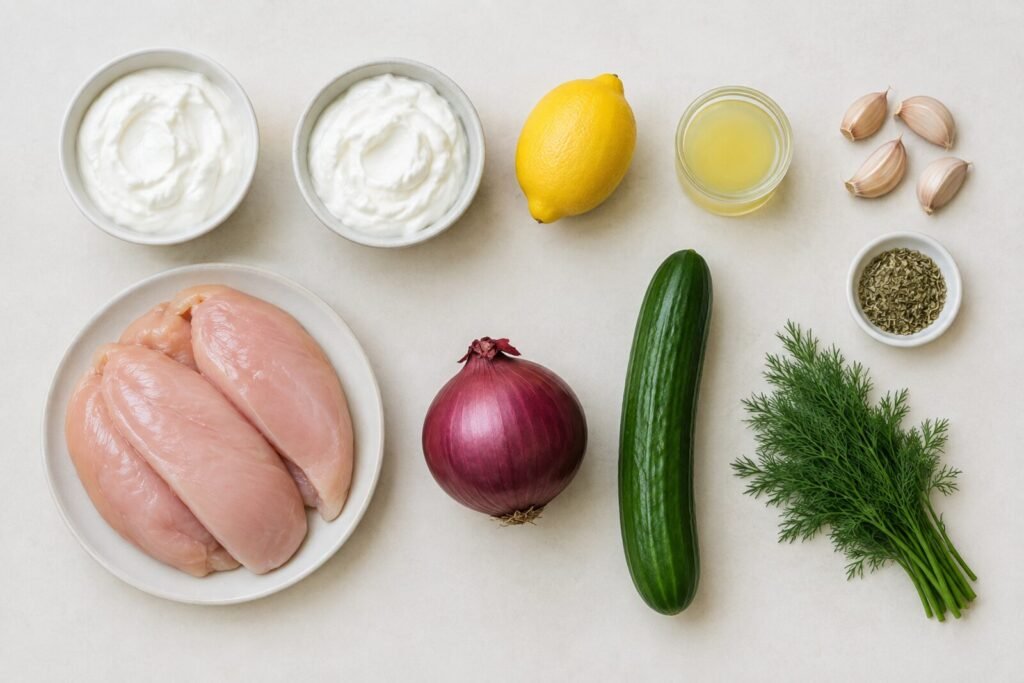
Boneless skinless chicken breasts (1½ lb / 680 g). Cut into even 1¼-inch cubes so every piece reaches temperature at the same time. Thighs forgive overcooking and add fat; the swaps table has them. Plain Greek yogurt (⅓ cup + 1 cup / 80 g + 225 g). Nonfat in the marinade, where it mostly cooks off; low-fat in the tzatziki, where the body shows. Buy strained yogurt, not "Greek-style" yogurt thickened with starch. We count all of the marinade in the panel, though some is left in the bowl. Dried oregano (2 tsp / 2 g). Greek or Mediterranean oregano if you can find it. It is the flavor people recognise as souvlaki, so use fresh-smelling oregano, not a jar from years ago. English cucumber (½ / 150 g). Thin skin and few seeds, so no peeling or seeding. Grate it on the coarse side of a box grater and squeeze it dry. Neutral oil for the grates (1 tsp / 4.5 g). Wiped on with a paper towel; most of it stays on the grate or burns off, so we count a quarter of the grate oil as eaten.
1 cup(225 g) 2% plain Greek yogurt, for the tzatziki
½English cucumber (150 g), coarsely grated and squeezed dry
1garlic clove (3 g), grated, for the tzatziki
1 tbsp(15 ml) lemon juice, for the tzatziki
2 tbsp(2 g) fresh dill, chopped
¼ tsp(1.5 g) fine salt, for the tzatziki
Lemon wedges, optional
Sliced tomato, optional
Method
Whisk the nonfat yogurt, olive oil, lemon zest, 3 tbsp lemon juice, 3 garlic cloves, oregano, ¾ tsp salt and pepper in a large bowl.
Add the chicken and turn to coat. Cover and refrigerate 1 hour, or up to 8 hours. Soak 8 wooden skewers in water for at least 30 minutes.
Make the tzatziki: stir the tzatziki yogurt, cucumber, 1 garlic clove, 1 tbsp lemon juice, dill and ¼ tsp salt together. Refrigerate until serving.
Heat the grill to medium-high, 425 to 450 °F (220 to 230 °C), lid closed, for 15 minutes. Scrub the grates, then wipe them with the neutral oil on a folded paper towel held in tongs.
Thread the chicken onto the skewers, alternating with onion and leaving a small gap between pieces. Let excess marinade drip off and discard what is left in the bowl.
Grill over direct heat, lid closed, turning every 3 minutes, for 10 to 12 minutes, until browned at the edges and the thickest cube reads 165 °F (74 °C).
Rest the skewers on a plate for 5 minutes. Serve with the tzatziki, lemon wedges and tomato.
Cook’s note
The small gap between cubes lets heat reach every side, so the outsides brown before the centres overcook; without a grill, broil the skewers on a rack over a foil-lined sheet pan, 4 inches from the element on high, for 10 to 12 minutes, turning twice.
Storage
Refrigerate the chicken 4 days and the tzatziki 3 days, separately. The cooked chicken freezes 2 months; the tzatziki does not freeze. Reheat the chicken covered in a 300 °F (150 °C) oven for 10 minutes, or eat it cold in a wrap.
Nutrition
Nutrition Facts
4 servings per recipeServing size 1 of 4 servings
Calories per serving320
% Daily Value*
Total Fat 10g
13%
Saturated Fat 2g
10%
Sodium 690mg
30%
Total Carbohydrate 10g
4%
Dietary Fiber 1.5g
5%
Total Sugars 5g
Protein 47g
94%
* The % Daily Value tells you how much a nutrient in a serving of food contributes to a daily diet. 2,000 calories a day is used for general nutrition advice.
How this panel was built
Every ingredient in this recipe is mapped to a USDA FoodData Central entry and the panel is computed from those entries for one serving as written. Optional ingredients and anything "to taste" are excluded. Values are rounded: protein to the gram, calories to the nearest 5 and sodium to the nearest 10 mg. The panel is calculated, not lab-tested; a different brand of stock or cheese will move sodium and fat. Cost per serving is an estimate at national-average store-brand prices; your store will differ.