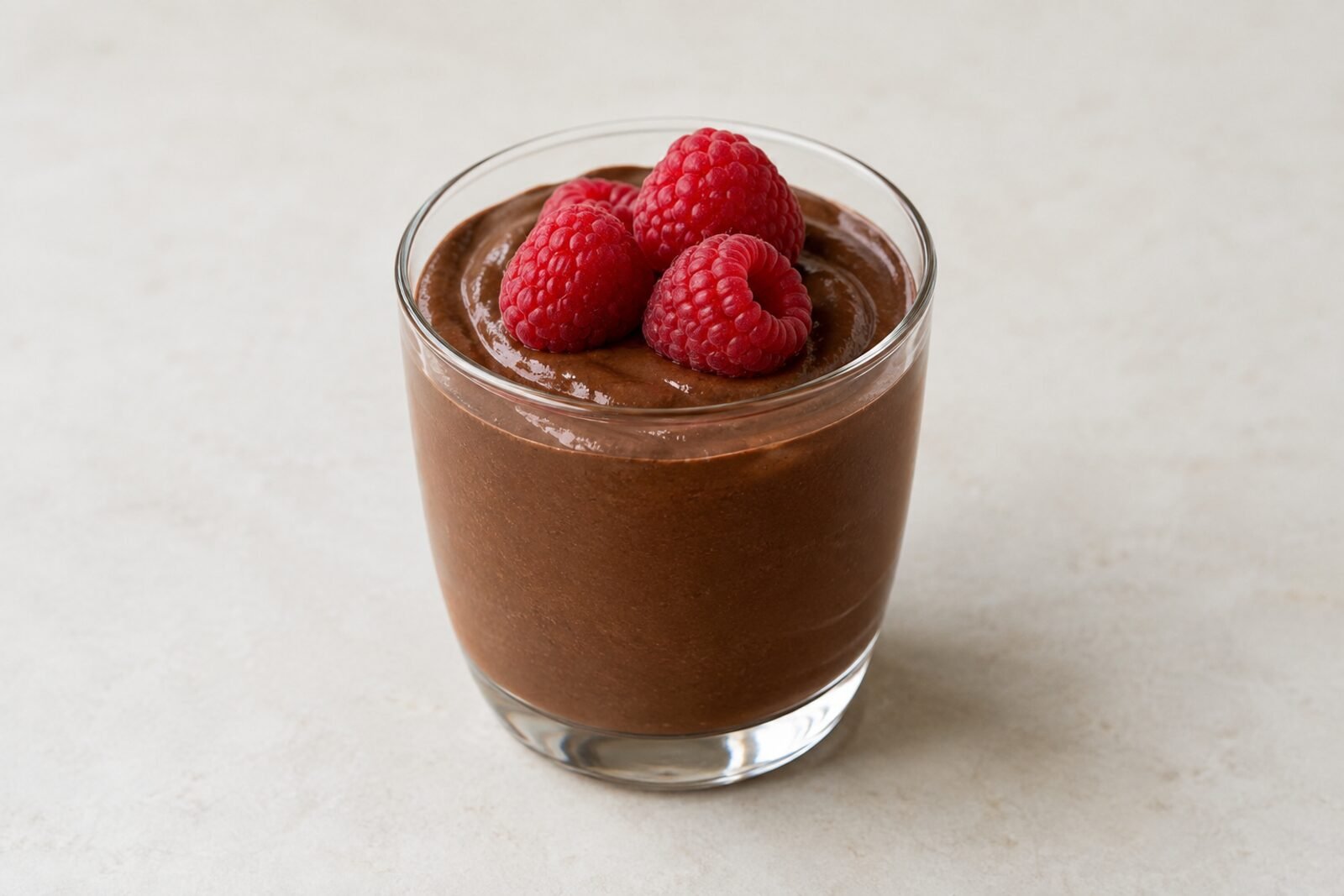
There is no cream, no egg white and no whipping in this mousse. Cottage cheese, blended long enough to lose every curd, takes cocoa and an ounce of melted dark chocolate and sets in the fridge into something thick and glossy. It tastes of chocolate first and tang second, which is the order we wanted, and the maple syrup is measured rather than poured.
Ten minutes in a food processor plus an hour of chilling. A blender works if you stop to scrape it down. Buy unsweetened cocoa, not hot-chocolate mix, and a bar of dark chocolate around 70 percent cacao; one ounce is a third of a standard bar. Five small glasses or ramekins hold it.
Why this one works
Three cups of cottage cheese are the whole base: 14 g of the 16 g protein per glass comes from the cheese, none from anything added.
Cocoa carries most of the chocolate flavor and 2 g of the 3 g fiber per glass, which keeps the melted chocolate to a single ounce.
The chocolate sets the mousse as it chills, so there is no cream, gelatin or egg; that ounce adds about 35 kcal per glass.
It keeps 4 days in the fridge, so a batch covers the week's desserts at $1.40 a serving.
Ingredient notes
Cottage cheese (2%, 3 cups / 675 g). A 24 oz tub is three cups almost exactly. Small curd blends a little faster. Full-fat makes a softer, richer mousse. Sodium is 420 mg per glass as written, nearly all from the cottage cheese; the no-salt-added swap takes off 400 mg. Cocoa powder (6 tbsp / 30 g). Natural or Dutch-process both work; Dutch is darker and milder. Sift it if it's lumpy or it speckles. Dark chocolate (70 percent cacao, 1 oz / 28 g). A small amount doing a structural job: it firms the mousse as it cools. Semisweet chips work and make it sweeter. Maple syrup (¼ cup / 80 g). Taste after blending. Cocoa varies, and a cook who wants it sweeter should know the panel is figured on the ¼ cup.
Scales every quantity and the servings count. The panel stays per serving.
1 oz(28 g) dark chocolate, about 70 percent cacao, chopped
3 cups(675 g) 2% cottage cheese
6 tbsp(30 g) unsweetened cocoa powder
¼ cup(80 g) maple syrup
1 tsp(4 g) vanilla extract
Flaky salt, optional
Raspberries for serving, optional
Method
Melt the chocolate in a small bowl in the microwave in 20-second bursts, stirring between, until smooth. Let it cool 5 minutes while you measure the rest.
Put the cottage cheese, cocoa, maple syrup and vanilla in a food processor.
Blend 2 minutes, scraping down twice, until smooth and glossy. Rub a little between your fingers; if you feel curd, keep going.
With the motor running, pour in the melted chocolate and blend 15 seconds more.
Divide among five small glasses or ramekins, about ⅔ cup each.
Chill at least 1 hour. The chocolate firms as it cools and turns the purée into mousse.
Top with a few flakes of salt or raspberries, if using.
Cook’s note
Pouring the chocolate in warm, with the motor running, keeps it from seizing into hard flecks against the cold cottage cheese.
Storage
Covered, 4 days in the fridge; it firms a little each day. Does not freeze well; it turns grainy when thawed.
Nutrition
Nutrition Facts
5 servings per recipeServing size 1 of 5 servings
Calories per serving200
% Daily Value*
Total Fat 6g
8%
Saturated Fat 3.5g
18%
Sodium 420mg
18%
Total Carbohydrate 23g
8%
Dietary Fiber 3g
11%
Total Sugars 17g
Protein 16g
32%
* The % Daily Value tells you how much a nutrient in a serving of food contributes to a daily diet. 2,000 calories a day is used for general nutrition advice.
How this panel was built
Every ingredient in this recipe is mapped to a USDA FoodData Central entry and the panel is computed from those entries for one serving as written. Optional ingredients and anything "to taste" are excluded. Values are rounded: protein to the gram, calories to the nearest 5 and sodium to the nearest 10 mg. The panel is calculated, not lab-tested; a different brand of stock or cheese will move sodium and fat. Cost per serving is an estimate at national-average store-brand prices; your store will differ.