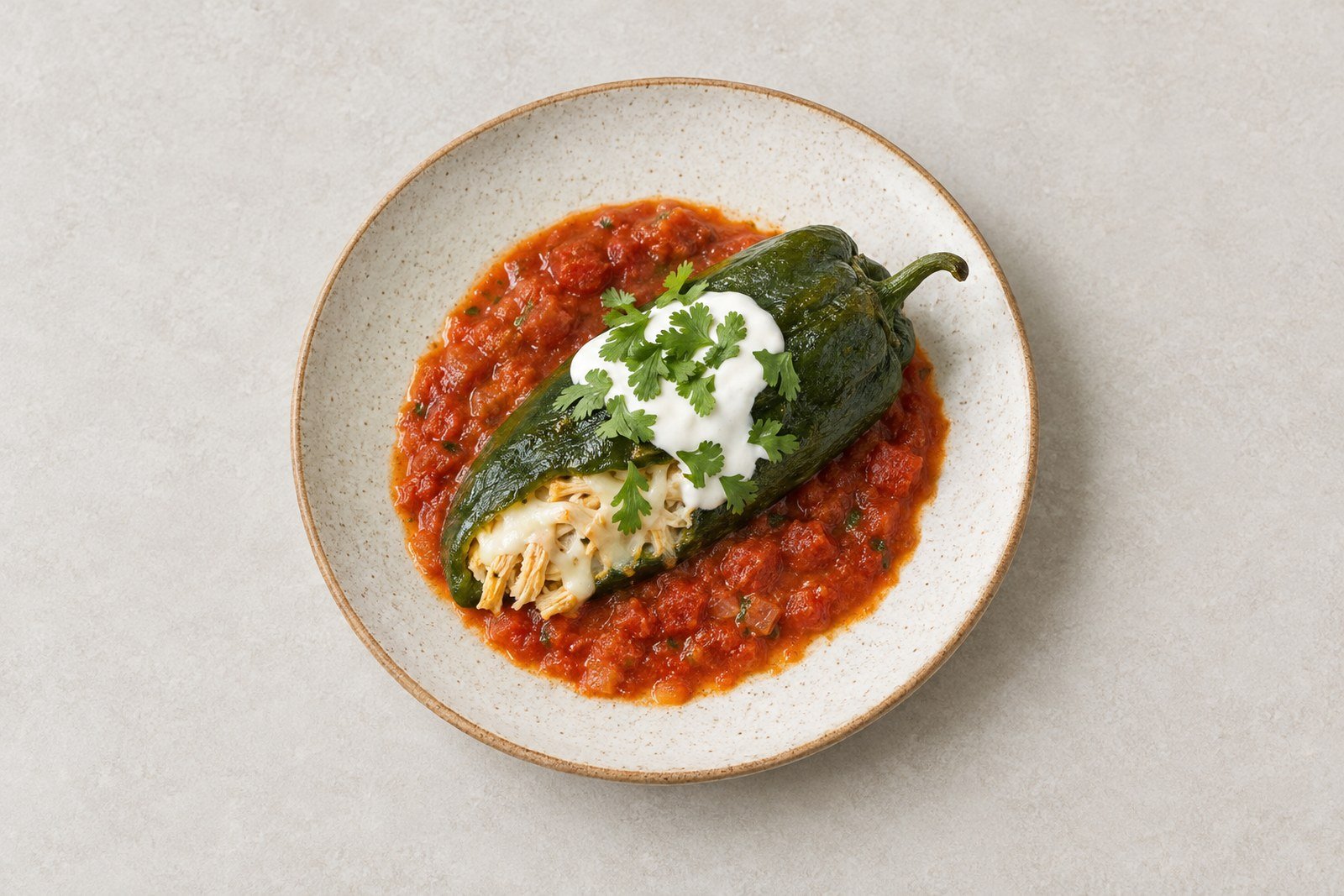
Chiles rellenos, “stuffed chiles”, are roasted poblano peppers filled with cheese, coated in a fluffy egg batter, fried and served in a thin tomato sauce. They are a classic of Puebla and now of Mexican restaurants everywhere. Ours skips the batter and the frying: the roasted poblanos are filled with shredded chicken and Monterey Jack and baked in a chunky tomato sauce.
About an hour, with leftover or poached chicken. Broiling the poblanos until the skins blacken is what lets them peel cleanly and gives them their smoky flavor. Poblanos are mild, but the odd one can be hot.
Why this one works
Two cups of chicken breast and a cup of Monterey Jack for four servings: 29 g of the 35 g protein per serving.
Baked instead of battered and fried: 8.5 g of the 13 g fat per serving is the cheese.
No-salt-added tomatoes and tomato sauce with half a teaspoon of salt: 290 mg of the 530 mg sodium per serving is the added salt.
A teaspoon of oil for the sauce: 1 g of the 13 g fat per serving, at $2.63 a serving.
Ingredient notes
Poblano peppers (4 large / 500 g). Look for wide, flat, straight peppers; they roast and stuff more easily. Cooked chicken breast (2 cups / 280 g, shredded). Leftover or poached chicken breast. Rotisserie chicken works but adds salt; if you need it gluten-free, check its label and the shredded cheese's. Monterey Jack (1 cup / 113 g, shredded). Melts smoothly; Oaxaca cheese is more traditional. No-salt-added tomatoes and tomato sauce. They cook down into a chunky tomato sauce for the peppers to bake in.
Scales every quantity and the servings count. The panel stays per serving.
4large poblano peppers (500 g)
1 tsp(4.5 g) avocado oil
½medium white onion (55 g), chopped
2garlic cloves (6 g), minced
114.5 oz can (411 g) no-salt-added diced tomatoes
1 cup(245 g) no-salt-added tomato sauce
½ tsp(0.5 g) dried oregano
½ tsp(3 g) fine salt
2 cups(280 g) shredded cooked chicken breast
1 cup(113 g) shredded Monterey Jack, divided
1 tsp(2 g) ground cumin
¼ cup(60 g) 2% Greek yogurt
¼ cup(4 g) chopped cilantro
Method
Heat the broiler with a rack about 4 inches from the heat. Broil the poblanos on a foil-lined baking sheet 8 to 10 minutes, turning every few minutes, until blackened all over. Put them in a bowl, cover and let them steam 10 minutes.
Meanwhile, heat the oil in a 12-inch ovenproof skillet over medium. Cook the onion 4 minutes, then the garlic for 30 seconds. Add the tomatoes with their juice, the tomato sauce, oregano and salt and simmer 8 minutes, until slightly thickened. Take the skillet off the heat.
Heat the oven to 400 °F (200 °C). Rub the blackened skins off the peppers. Cut a slit down one side of each, keeping the stem on, and scrape out the seeds.
Mix the chicken with ¾ cup of the cheese and the cumin. Fill the peppers, close them over the filling and lay them in the sauce. Sprinkle with the remaining cheese.
Bake 15 to 18 minutes, until the cheese melts and the filling is hot (165 °F / 74 °C). Top with the yogurt and cilantro.
Cook’s note
Peel the peppers by rubbing the skin off with your fingers or a paper towel, not under running water. Rinsing washes away the smoky flavor the broiler just gave them.
Storage
Refrigerate in the sauce up to 4 days and reheat, covered, at 350 °F (175 °C) for 15 to 20 minutes. They freeze up to 3 months.
Nutrition
Nutrition Facts
4 servings per recipeServing size 1 of 4 servings
Calories per serving325
% Daily Value*
Total Fat 13g
17%
Saturated Fat 7g
35%
Sodium 530mg
23%
Total Carbohydrate 20g
7%
Dietary Fiber 5g
18%
Total Sugars 12g
Protein 35g
70%
* The % Daily Value tells you how much a nutrient in a serving of food contributes to a daily diet. 2,000 calories a day is used for general nutrition advice.
How this panel was built
Every ingredient in this recipe is mapped to a USDA FoodData Central entry and the panel is computed from those entries for one serving as written. Optional ingredients and anything "to taste" are excluded. Values are rounded: protein to the gram, calories to the nearest 5 and sodium to the nearest 10 mg. The panel is calculated, not lab-tested; a different brand of stock or cheese will move sodium and fat. Cost per serving is an estimate at national-average store-brand prices; your store will differ.