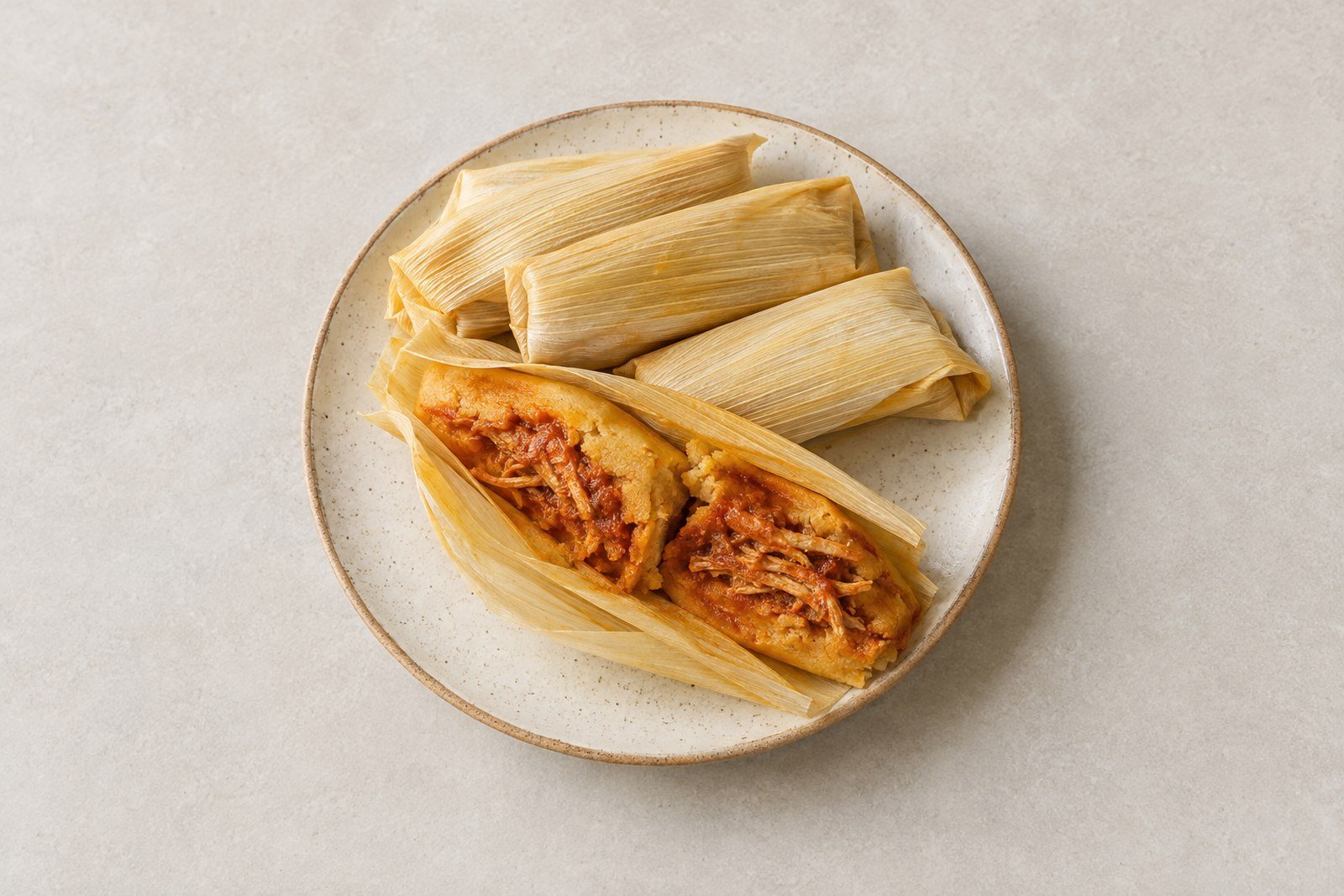
Tamales are a Christmas tradition in Mexico and across the Southwest, often made in big batches with family. Ours fills a tender corn masa with shredded chicken in a guajillo chile sauce, wraps each one in a corn husk and steams it until the masa pulls cleanly away. We use avocado oil in place of the traditional lard.
About 3 hours 15 minutes, with plenty of hands-off time while the husks soak and the tamales steam. Line up the masa, the filling and the husks and it goes quickly, especially with a second pair of hands. Two tamales make a serving, and they freeze well for another night.
Why this one works
A pound and a half of chicken breast for 16 tamales: 19 g of the 25 g protein per serving.
Avocado oil in place of lard: 9 g of the 14 g fat per serving, with 2 g saturated in all.
A guajillo chile sauce with no added sugar: 2.5 g sugars per serving.
Two tamales a serving at $1.49, with 375 calories and 350 mg sodium.
Ingredient notes
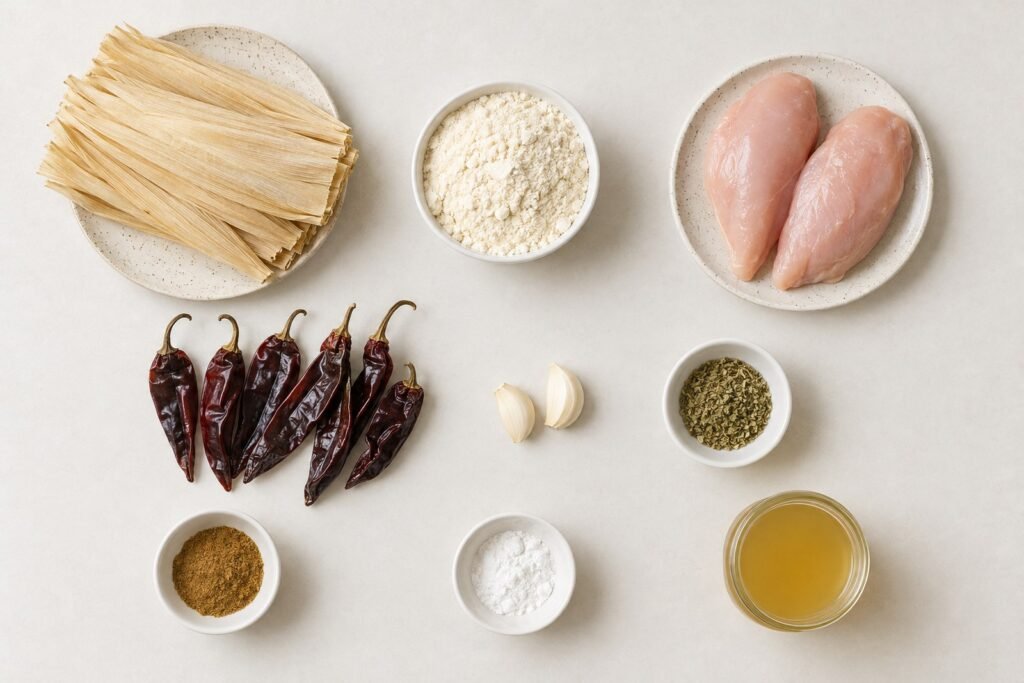
Masa harina (3 cups / 360 g). Corn flour treated with lime, sold near the regular flour or in the Latin foods aisle. Cornmeal won't work here. Dried guajillo chiles (6, 36 g). Fruity and mild. Stem and seed them, and toast only until fragrant; burnt chiles turn bitter. Corn husks (24). Soak them until pliable. You'll need 16 good ones for the tamales plus extras to tear into ties and line the steamer. Use the widest husks, or overlap two small ones. Avocado oil (⅓ cup / 73 g). Any neutral oil works. It keeps the masa soft and moist, with a milder flavor than lard.
Scales every quantity and the servings count. The panel stays per serving.
24dried corn husks (counted at zero)
1½ lb(680 g) boneless skinless chicken breast
6dried guajillo chiles (36 g), stemmed and seeded
2garlic cloves (6 g)
½ tsp(1 g) dried oregano
½ tsp(1.2 g) ground cumin
¼ tsp(1.5 g) fine salt, for the sauce
3 cups(360 g) masa harina
1 tsp(4.6 g) baking powder
½ tsp(3 g) fine salt, for the masa
⅓ cup(73 g) avocado oil
2½ cups(600 ml) low-sodium chicken stock, warmed
Method
Soak the corn husks in a large bowl of hot water, weighted with a plate, about 30 minutes. Meanwhile, put the chicken in a saucepan, cover with water and simmer gently until cooked through, 15 to 18 minutes. Cool and shred it.
Toast the chiles in a dry skillet, about 20 seconds per side, until fragrant. Cover with boiling water and soak 15 minutes. Drain, reserving ½ cup of the water. Blend the chiles, reserved water, garlic, oregano, cumin and the sauce salt until smooth. Toss with the chicken.
Whisk the masa harina, baking powder and masa salt in a large bowl. Stir in the oil and then the warm stock. Knead by hand until it's soft and spreadable, like thick hummus, adding a little more stock if needed.
Drain a husk, smooth side up. Spread about ¼ cup of masa in a rectangle, leaving the pointed end clear. Add about ¼ cup of filling down the center (divide it evenly among the 16), fold the sides over the filling and fold up the pointed end. Tie with a strip of husk if you like. Repeat to make 16.
Stand the tamales open end up in a steamer basket set over simmering water in a large pot, lined with extra husks. Cover and steam 60 to 75 minutes, adding hot water as needed, until the masa pulls cleanly from the husk. Let stand 15 minutes before serving.
Cook’s note
Test one before you call them done. Take a tamal out, let it sit 5 minutes and unwrap it: the masa should pull away from the husk cleanly. If it sticks, steam them 10 to 15 minutes more.
Storage
Refrigerate within 2 hours, up to 4 days. Steam 10 minutes to rewarm. Freeze in their husks up to 3 months and steam from frozen about 25 minutes.
Nutrition
Nutrition Facts
8 servings per recipeServing size 1 of 8 servings
Calories per serving375
% Daily Value*
Total Fat 14g
18%
Saturated Fat 2g
10%
Sodium 350mg
15%
Total Carbohydrate 39g
14%
Dietary Fiber 4.5g
16%
Total Sugars 2.5g
Protein 25g
50%
* The % Daily Value tells you how much a nutrient in a serving of food contributes to a daily diet. 2,000 calories a day is used for general nutrition advice.
How this panel was built
Every ingredient in this recipe is mapped to a USDA FoodData Central entry and the panel is computed from those entries for one serving as written. Optional ingredients and anything "to taste" are excluded. Values are rounded: protein to the gram, calories to the nearest 5 and sodium to the nearest 10 mg. The panel is calculated, not lab-tested; a different brand of stock or cheese will move sodium and fat. Cost per serving is an estimate at national-average store-brand prices; your store will differ.