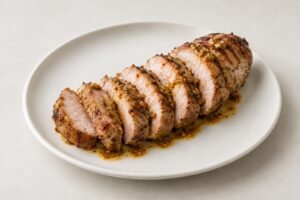
Pork tenderloin is the leanest cut in the pork case and the quickest to overcook, so we give it two jobs on two zones of the grill: a hard sear over direct heat, then a covered finish on the cool side while a mustard and honey glaze sets. Pulled at 145 °F (63 °C) and rested, the centre stays faintly pink, which is where tenderloin should be.
Two 1-pound tenderloins feed four at dinner, and the slices hold up cold for lunches through the week. Buy them unseasoned; the pre-marinated packs carry a lot more salt and sugar than this glaze. Trim the silverskin, the thin shiny membrane, with the tip of a knife, and tie the thin tail under so the whole piece cooks at one rate.
Why this one works
49 g protein per serving, 48 g of it from the tenderloin, with 10 g fat in all, including the measured tablespoon of oil in the rub.
The glaze is whole-grain mustard, cider vinegar and 1 tbsp honey for the whole recipe, which adds about 30 kcal a serving.
The two-zone method brings the centre up gently over 10 to 14 minutes, so lean meat stays juicy at 145 °F.
It keeps 4 days and slices cold for salads and sandwiches, at $2.85 a serving.
Ingredient notes
Pork tenderloin (two, about 1 lb each / 910 g). Not pork loin, which is a wider roast that takes three times as long. Unseasoned, from the meat case. Whole-grain mustard (2 tbsp / 30 g). The seeds pop in the heat and stay visible in the glaze. Dijon alone works and looks plainer. Honey (1 tbsp / 21 g). Just enough to caramelise. It goes on during the indirect stage because it burns over direct flame. Fresh rosemary (1 tbsp chopped / 2 g). Chopped fine so it does not scorch. 1 tsp dried, crumbled, works. Neutral oil for the grates (1 tsp / 4.5 g). Wiped on and mostly burned off, so we count a quarter of the grate oil as eaten.
Scales every quantity and the servings count. The panel stays per serving.
2pork tenderloins, about 1 lb each (910 g total), silverskin trimmed
2 tbsp(30 g) Dijon mustard
1 tbsp(14 g) olive oil
2garlic cloves (6 g), grated
1 tbsp(2 g) fresh rosemary, finely chopped
¾ tsp(4.5 g) fine salt
½ tsp(1 g) black pepper
2 tbsp(30 g) whole-grain mustard
1 tbsp(21 g) honey
1 tbsp(15 ml) cider vinegar
1 tsp(4.5 g) neutral oil, for the grates
Method
Pat the tenderloins dry. Fold the thin tail end under and tie it with kitchen string so each tenderloin is an even thickness.
Stir the Dijon, olive oil, garlic, rosemary, salt and pepper together and rub it all over the pork. Let it sit while the grill heats, about 15 minutes.
Stir the whole-grain mustard, honey and cider vinegar together in a separate small bowl for the glaze. Divide it between two cups.
Set up two zones: burners on high on one side and off on the other, or coals banked to one side. Heat, lid closed, to about 450 °F (230 °C). Scrub the grates and wipe them with the neutral oil.
Sear the pork over direct heat, lid open, 2 minutes on each of its four sides, until browned all over.
Move the pork to the cool side. Brush it with the first cup of glaze, close the lid and cook 10 to 14 minutes, until the thickest part reads 145 °F.
Move the pork to a board, spoon over the second cup of glaze and rest 5 minutes. Snip the string and slice ½ inch thick.
Cook’s note
The two zones do separate jobs, the direct side making the crust and the covered indirect side bringing the centre up without burning the honey; without a grill, sear in an oven-safe skillet, glaze, and finish in a 425 °F (220 °C) oven for 10 to 14 minutes.
Storage
Refrigerate whole or sliced for 4 days; it slices thinner cold, for salads, grain bowls and sandwiches. Freeze sliced portions up to 3 months. Reheat covered at 300 °F (150 °C), or in a skillet with a splash of water, just until warm.
Nutrition
Nutrition Facts
4 servings per recipeServing size 1 of 4 servings
Calories per serving320
% Daily Value*
Total Fat 10g
13%
Saturated Fat 2g
10%
Sodium 700mg
30%
Total Carbohydrate 6g
2%
Dietary Fiber 1g
4%
Total Sugars 4.5g
Protein 49g
98%
* The % Daily Value tells you how much a nutrient in a serving of food contributes to a daily diet. 2,000 calories a day is used for general nutrition advice.
How this panel was built
Every ingredient in this recipe is mapped to a USDA FoodData Central entry and the panel is computed from those entries for one serving as written. Optional ingredients and anything "to taste" are excluded. Values are rounded: protein to the gram, calories to the nearest 5 and sodium to the nearest 10 mg. The panel is calculated, not lab-tested; a different brand of stock or cheese will move sodium and fat. Cost per serving is an estimate at national-average store-brand prices; your store will differ.