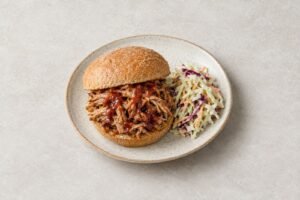
Pulled pork is the Southern barbecue standard: pork shoulder cooked low and slow until it falls apart, shredded and piled on a bun with barbecue sauce. Pitmasters smoke it for hours; the slow cooker gets the same tender meat with no smoker. Ours trims the shoulder of its thick fat before cooking, uses a smoked-paprika rub, and adds a measured half cup of barbecue sauce for eight sandwiches.
Fifteen minutes in the morning and 8 to 10 hours on low. Shred the pork, skim the fat off the cooking liquid, and moisten the meat with some of that liquid so the sandwiches don’t need much sauce. It makes eight sandwiches; refrigerate what you’ll eat within 4 days and freeze the rest.
Why this one works
Three pounds of trimmed pork shoulder for eight sandwiches: 32 g of the 40 g protein per sandwich, with 7 g from the bun.
The fat trimmed before cooking and skimmed after: 9.5 g of the 13 g fat per sandwich is the pork.
A half cup of barbecue sauce for eight sandwiches: 30 of the 440 calories and 180 mg of the 820 mg sodium per sandwich.
Whole-wheat buns: 160 of the 440 calories and 285 mg of the 820 mg sodium, at $1.81 a sandwich.
Ingredient notes
Boneless pork shoulder (3 lb / 1.36 kg, trimmed). Also sold as Boston butt. Buy about 4 pounds and cut off the thick outer fat and large seams; enough stays in the meat to keep it moist. Smoked paprika (1 tbsp / 7 g). It gives the smoky flavor a smoker would. Apple cider vinegar (¼ cup / 60 ml). It cuts the richness, as the vinegar sauces of the Carolinas do. Whole-wheat hamburger buns (8). Check the label if you need the dish dairy-free; some buns contain milk or whey. Barbecue sauce (½ cup / 140 g). About a tablespoon per sandwich; any bottled sauce you like works.
Scales every quantity and the servings count. The panel stays per serving.
3 lb(1.4 kg) boneless pork shoulder, trimmed of fat (from about 4 lb untrimmed)
1 tbsp(7 g) smoked paprika
2 tsp(5.4 g) chili powder
1 tsp(3 g) garlic powder
1 tsp(2.4 g) onion powder
1 tsp(2 g) ground cumin
¾ tsp(4.5 g) fine salt
½ tsp(1.2 g) black pepper
1 tbsp(13 g) packed brown sugar
1medium yellow onion (110 g), sliced
½ cup(120 ml) low-sodium chicken stock
¼ cup(60 ml) apple cider vinegar
½ cup(140 g) barbecue sauce
8whole-wheat hamburger buns
Method
Cut the pork into 3 or 4 large chunks. Mix the paprika, chili powder, garlic powder, onion powder, cumin, salt, pepper and brown sugar and rub it all over the pork.
Scatter the onion in a 6-quart slow cooker and set the pork on top. Pour the stock and vinegar around the pork.
Cover and cook 8 to 10 hours on LOW or 5 to 6 hours on HIGH, until the pork pulls apart easily with a fork.
Lift the pork onto a board, shred it with two forks and discard any fat. Skim the fat from the cooking liquid, then toss the pork with about ½ cup of the liquid.
Toast the buns. Pile the pork on the buns and top each with 1 tbsp of the barbecue sauce.
Cook’s note
Moisten the shredded pork with its own skimmed cooking liquid before reaching for the sauce. The liquid carries the rub's flavor and keeps the meat juicy, so a tablespoon of sauce per sandwich is plenty.
Storage
Refrigerate the pork in a little of its cooking liquid up to 4 days. It freezes up to 3 months. Reheat covered, with a splash of the liquid or water.
Nutrition
Nutrition Facts
8 servings per recipeServing size 1 of 8 servings
Calories per serving440
% Daily Value*
Total Fat 13g
17%
Saturated Fat 4g
20%
Sodium 820mg
36%
Total Carbohydrate 39g
14%
Dietary Fiber 4.5g
16%
Total Sugars 12g
Protein 40g
80%
* The % Daily Value tells you how much a nutrient in a serving of food contributes to a daily diet. 2,000 calories a day is used for general nutrition advice.
How this panel was built
Every ingredient in this recipe is mapped to a USDA FoodData Central entry and the panel is computed from those entries for one serving as written. Optional ingredients and anything "to taste" are excluded. Values are rounded: protein to the gram, calories to the nearest 5 and sodium to the nearest 10 mg. The panel is calculated, not lab-tested; a different brand of stock or cheese will move sodium and fat. Cost per serving is an estimate at national-average store-brand prices; your store will differ.